Long-term ownership in a passive market
Artificial intelligence has become a large question mark over the future of many companies. It hit a public market that was rebuilt over 20 years to trade without an opinion or patience. The collision is mispricing the small group of companies that will matter most, more often and more sharply than at any time in my career. Traditional buy and hold was not built for this market. This is a map of what happened to the machinery of prices, and of the fundamental investing discipline that works within it.
July 2026
This essay is market commentary. It is not an offer or solicitation of any kind. Notices on the final page.
At 3:55pm on May 29, 2026, one of the best businesses I have studied, NVIDIA, lost ~$120 billion of market value, about 3% of its market cap, in the ~300 seconds before the market close. There were no customer issues reported. No product delays. Quarterly business performance was almost certainly progressing as it had been up to that point. The culprit was the MSCI semi-annual index review. New index weights take effect at the market close, so passive funds tracking those indexes had to adjust, so a wall of mechanical selling flooded the market. NVIDIA’s target weight had simply changed. The selling was not a reaction to the business. A $4+ trillion company was repriced by 3% in minutes because an index changed its weights.
I have spent nearly 15 years working to understand a few hundred of the strongest companies in the world, and the ones becoming them, well enough to have a view on their respective valuations, and then waiting for the market to present dislocations. For most of those years the dislocations happened from time-to-time. They were more occasional. A generational company might look unusually mispriced once or twice a cycle. The work was to notice, act, and then wait. That market is gone and probably isn’t coming back anytime soon. The disagreements that can lead to wild pricing swings now arrive weekly, clustered around many of the same companies, and they overshoot what the businesses’ performance beneath justifies in many cases.
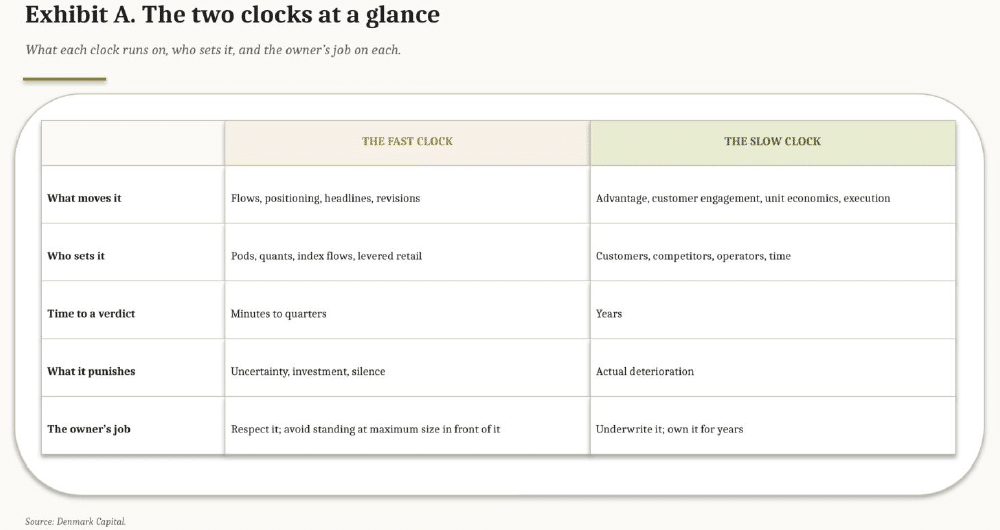
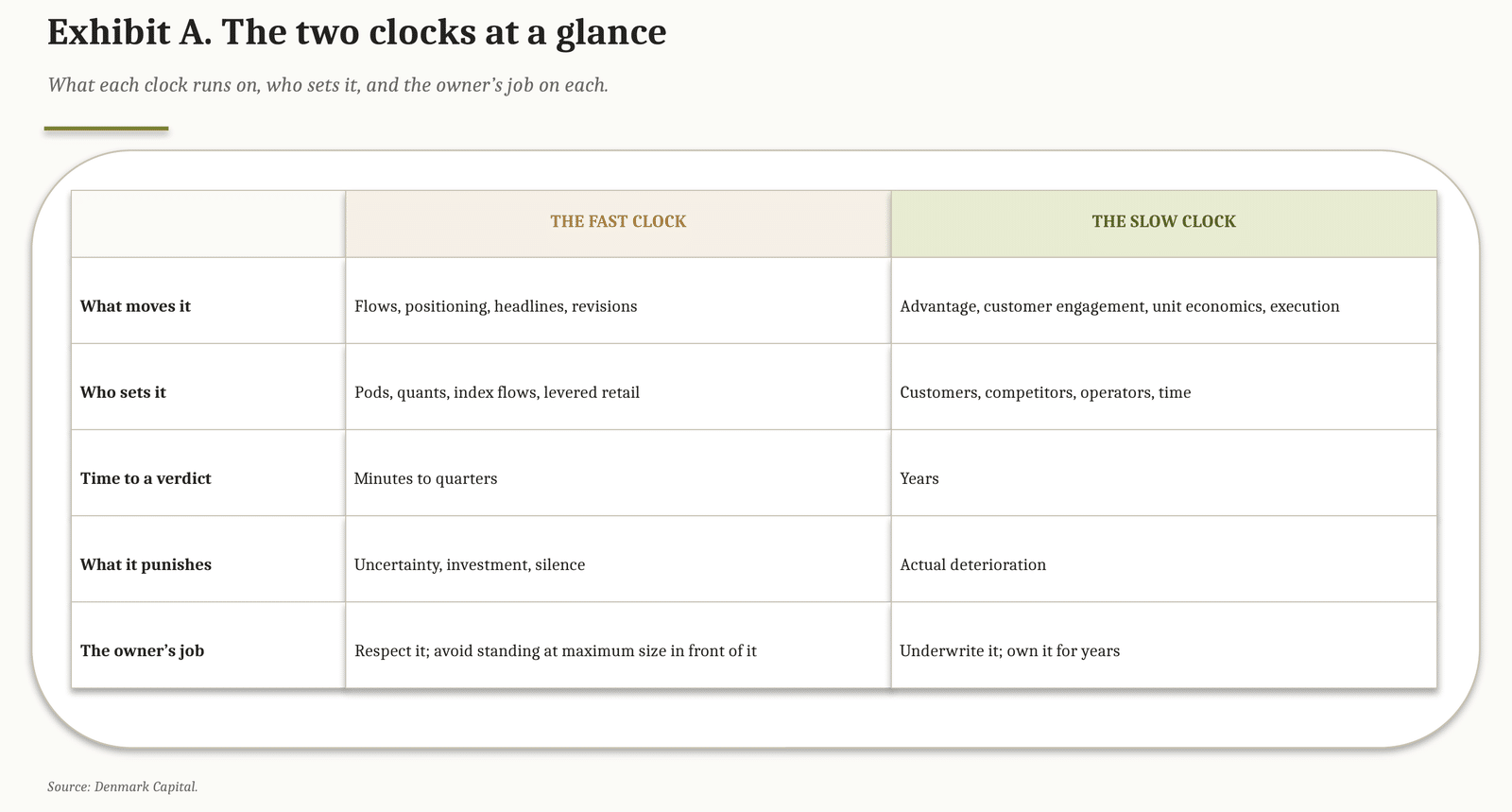
This is the way I have come to see it. Every publicly-listed company now runs on two clocks. The slow clock is the business: revenue, margins, reinvestment and returns, the free cash flow per share that compounds over years and, for the rare enterprise, over decades. The fast clock is the price, which can be influenced dramatically by flows, factors, hedges, posts, headlines, and now by AI-related progress that can make the future of more and more companies seem less clear for a time. What has happened, and what the industry has been slow to acknowledge, is that the machinery setting prices has been rebuilt to give the slow clock less and less weight, and then artificial intelligence dropped a bomb of slow clock uncertainty onto the fast clock. Great businesses compound value on the slow clock. Today’s market trades on the fast clock. The opportunity of this era for true investors is the gap between them.
Reading the slow clock while most of the market trades the fast clock is, I believe, one of the largest opportunities in public equities today. There are many ways to win in markets. But for investors whose craft is underwriting exceptional businesses over long periods of time, the machinery of today’s public markets, now having to apply itself to AI developments and all of the company-specific controversies it can create, presents some great opportunities for fundamental investors that can acknowledge and respect both clocks without losing sight of the slow one. Reading the slow clock has also become, for reasons this essay will make clear, one of the least crowded seats in the industry.
The seat itself has changed, though. The original training was to identify and buy quality that wasn’t highly cyclical and wait, and to accept a 40-50% drawdown once in a blue moon as the toll. That training was designed for a different market. Today the machine can take 25%+ of a great company’s value away in one quarter, on a fear that starts with a viral post on X and builds off a modest slowdown or execution misstep, and AI has spread that kind of fear across multiple industries at the same time.
So you cannot simply sit there and hold in large size nearly as often. You cannot trade without structure either, because there will be many others far better at trading than you. The right adaptation is a third thing that I call slow-clock ownership: own the rarest compounders, the enduring innovators as I call them, for years, but while aiming to avoid standing in large size in front of protracted debates that you have identified early enough to act on. The slow clock still wins, but not nearly the same way if there is no awareness of how the fast clock now runs. Most of this essay is the case for why today’s market now demands a different discipline from the fundamental investor if your required return is high enough. The later parts describe the process that can better inform position sizes, and what it takes to practice it for decades.
What follows is written for those who own, allocate to, or simply have interest in public equities, and who already sense, as I do, that the ground under them has moved.
◆ THE TEST
The Two-Clock Test
The discipline required to exploit the gap between the slow clock and the fast one runs through 5 questions, which should be asked in order. The rest of this essay is the case for why these questions now decide outcomes and some of the companies we’ve run this test on, including the ones where we failed it.
- The few. Does this business belong to the small group of companies capable of compounding free cash flow at elevated rates for a decade or more? Strongest form advantage, rare value proposition, a large and growing market, relentless product innovation, financial strength, exceptional operators with founder-level urgency, agility? If not, the end. The mediocre business is usually too difficult to rescue and comes with great opportunity cost.
- The clock. Is the market judging this company on the wrong clock: pricing a multi-year question as if it must be answered this quarter? If the price and the business are moving on the same clock, there might be a disagreement, but there is no clock mismatch.
- The mechanism. Which documented mispricing setup is producing the clock mismatch: flows, factor pressure, pod de-risking, an investment period read as impairment, an AI label causing a sector rotation, a regulatory question, a temporary period of underperformance that is being priced as multi-year? If you do not know the mispricing mechanism, you do not have a variant perception.
- The KPIs. Which slow clock indicators would show the business is intact or breaking, and at what levels does the thesis fail? Customer retention, market share, unit economics, incremental margins, capital allocation: the KPIs that matter, marked against your expectations.
- The weight. After adding views on timeliness, controversy magnitude and duration, and the distance between price and your appraisal of intrinsic value, ask: how large right now? Ownership is decided primarily by questions 1 and 3. Question 5 helps determine size, and it is an answer that can change quickly.
The questions are not the edge. The edge is the library of documented heuristics and setups behind questions 1 and 3, the thousands of company reps behind questions 1, 3 and 4, and the discipline to let question 5 overrule the optics and your ego.
◆ IN BRIEF
The theory
Great businesses compound value on the slow clock, today’s market trades on the fast clock, and the opportunity is the gap. What has happened, and what is required:
I. The wave that touches everything. Capable, agentic AI finds its way into every income statement, forcing the market to re-underwrite the future of nearly every company at once: the obvious beneficiaries, the businesses filed too quickly under “AI loser,” and the uncertain middle.
II. No opinion, no patience. Two decades of passive and systematic capital changed the price-setting machine, and a large, levered retail crowd is now impactful. Passive took away the market’s opinion. The quants and the multi-strategy pods took away its patience. Retail became a structural bid with conviction but less focus on valuation, buying the dips in a smaller set of companies and running short-dated leverage. In the best academic estimate, a dollar of net equity flow can move the aggregate market by approximately $5. The marginal price, especially in the tails, is increasingly set by flows, positioning, and risk limits rather than by patient judgment about what the business should be worth.
III. The volatility. Feed today’s market structure an endless supply of unknowable AI questions and more of the greatest businesses on earth swing wildly and more often on narrative rather than results. The earnings day move has gone vertical, implied volatility now rises while stocks rally, and many are paying a premium for more upside. The kind of drawdown once associated with rare periods of extreme fear can now arrive in a single company or cohort in a month, on a slow-resolving debate meeting a modest disappointment in results.
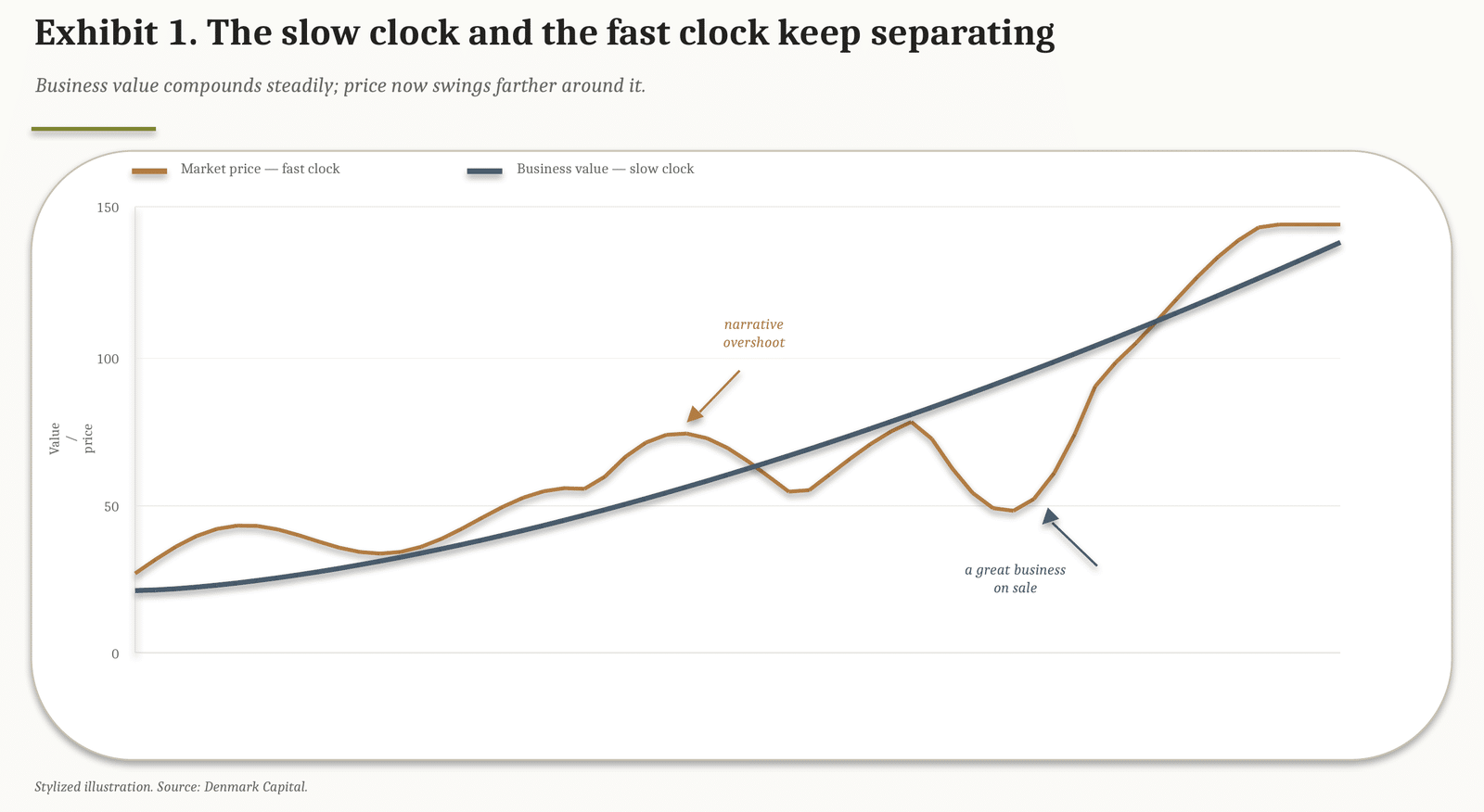
IV. The divergence, and the sizing response. Value compounds along the slow clock. Price swings far around it on the fast clock. The work is now two things: consistently separating a dislocation from a deterioration, and sizing positions so the market cannot run you over while it (not you) is still early in making this determination. Timeliness, the expected depth and duration of a controversy, and variant perception on valuation play a role in position-sizing. The rarity, defensibility, and long-term opportunity of the asset govern ownership.
V. The few. ~2-4% of public companies have created all of the net wealth in the history of public markets. The prize was always the few. What is new is that the few are now mispriced more often, right as the rest of the market has been built to move away from them.
VI. The specialty hiding in plain sight. The investors built to capture this have been called generalists for their entire careers. They are the opposite. The specialty is rare and, because it is hard and exceedingly difficult to market, only becoming less competitive.
VII. What it takes. Slow-clock ownership requires a rare combination of advantages, held inside a small, aligned structure: long horizon business judgment rooted in proprietary heuristics, a documented library of recurring mispricings, the discipline to resize without losing ownership, and the temperament to look wrong for long stretches. The tools available to practice this craft are experiencing a revolution, but the craft is not getting easier. The field of great companies is widening. The market’s willingness to misprice them is increasing. The number of investors structurally and behaviorally able to exploit those mispricings remains small.
◆ PART I
The wave that touches everything
Capable AI agents have arrived, and they are becoming infrastructure the way electricity once did. They are something every company will use and every income statement will reflect.
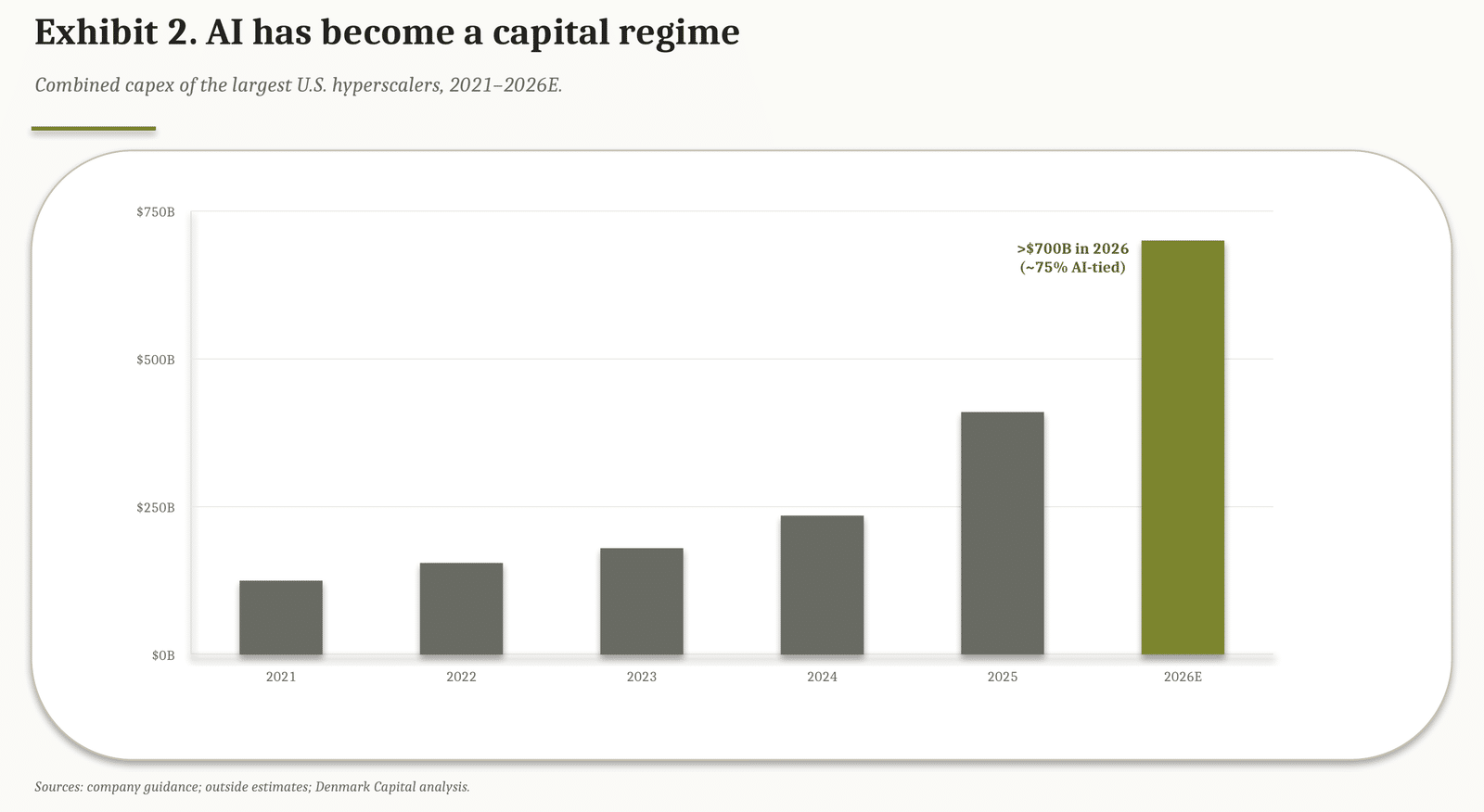
The capital behind it is already large. In 2026 the largest U.S. hyperscalers, Amazon, Alphabet, Meta, Microsoft, and Oracle, are guiding to >$700 billion of combined capital expenditure (capex), up from ~$410 billion the year before, with ~75% of it tied directly to AI infrastructure by outside estimates. That is capex for one year, across only five companies, committed to building the fuel for a technology whose end state none of them fully know, and current trends suggest >$1 trillion of capex in 2027. When that much capital moves that fast, a new regime has arrived.
The pace of AI progress has been impressive. Three years ago these systems struggled to hold a paragraph together. Today they write and debug production code and operate software. The transition that affects valuations and is happening right now is going from a model that answers our questions to an agent that takes an objective, makes a plan, uses tools, and completes long chains of work for us with little supervision. The tech goes from making a knowledge worker faster to performing a growing share of the work itself.
You only have to accept two things to take the investing consequence seriously. The first is that the market-level uncertainty AI introduces about the future of most businesses is huge. The second is that this market-level uncertainty resolves slowly, over years of shipped products and reported business performance.
The distance between how fast the AI-related narratives move and how slowly the truth is proven out is the key focus. The arrival of capable agents will create new winners, but it has also put a question mark over the terminal value of large chunks of the market at the same time. For many years, the assumption embedded in most equity valuations was that the competitive map of 2032 would look much like today’s. For example, the same software incumbents collecting the same per-seat subscriptions and at similar gross margins, the same marketplaces controlling the same user experiences, the same brands retaining the same loyalty. Agents put that assumption in play across the board. If software can be generated on demand, what is a seat worth? If incremental revenue requires token spend, where do gross margins go? The same questions now hang over the storefront if an agent places the order, and over the content library if competent content is easy to produce.
The market is now trying to answer all of these questions in short order, and it is doing so along a spectrum. At one end are the obvious beneficiaries: the chip designers, the foundries, the equipment makers, where the argument is about magnitude and duration rather than direction. At the other end are the businesses the market has filed under “AI loser,” led by per-seat software, where the fear is disruption. In the middle is nearly all the rest. Marketplaces, payment networks, media, information services, healthcare, consumer platforms, where AI is neither a clear saving grace nor clear existential threat but some unresolved mix the market is wrestling with. The label a company receives in this sorting can be worth, in one quarter, 25%+ of its market value. And the labels are being distributed by a market that, as the next part shows, is the worst-equipped it has been to assign them appropriately.
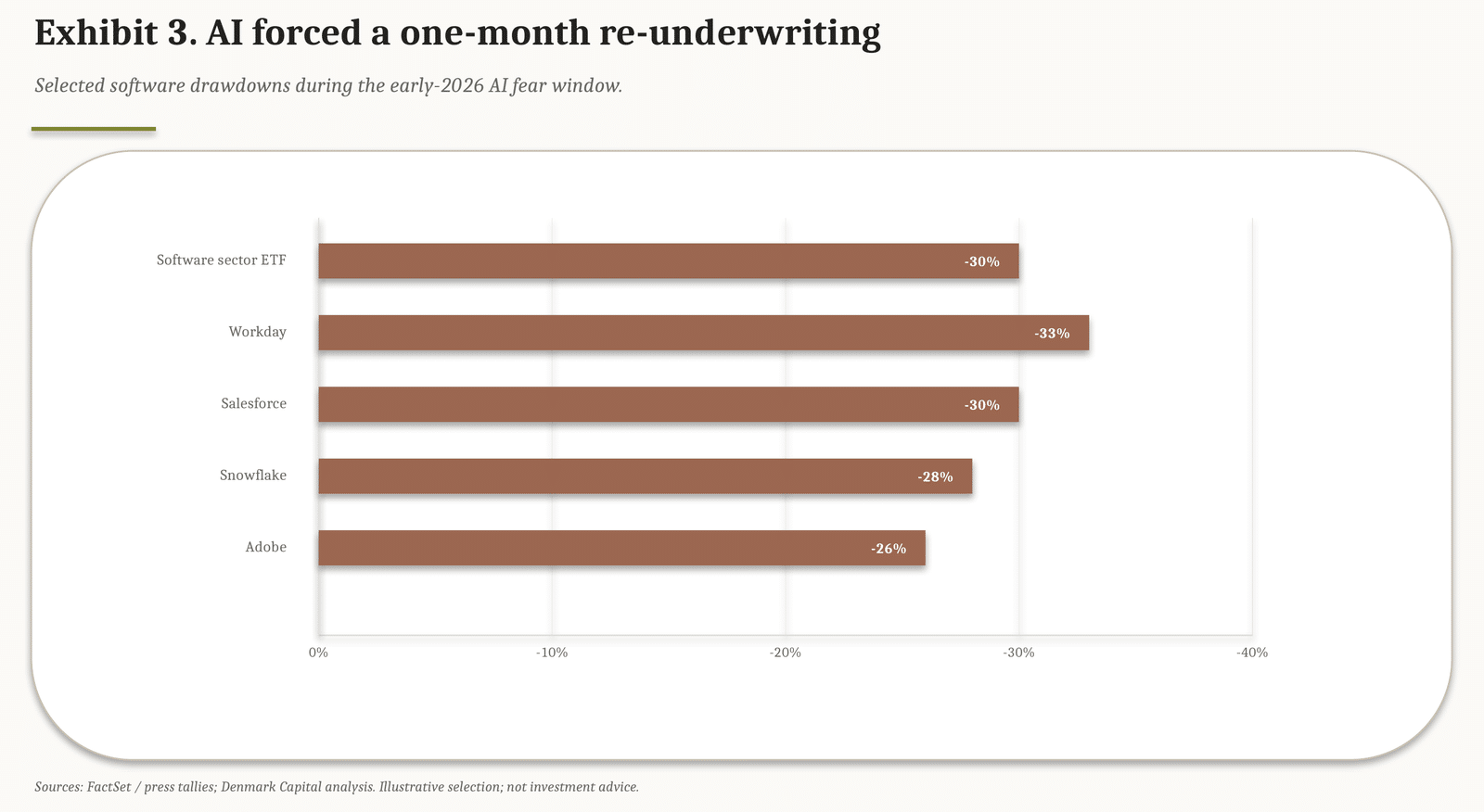
The re-underwriting has become indiscriminate. Between mid-January and mid-February of 2026, ~$2 trillion of software-sector market value evaporated in about a month, triggered mainly by the release of capable AI agents and the fear of what they mean for per-seat software. The main software exchange-traded fund quickly fell >30% from its September high. Salesforce fell ~30%. Workday fell ~33%. Most of these companies have grown revenue straight through the panic. It became a terminal value issue. They were repriced on fears about the future that the market cannot resolve yet, and so re-litigated week-in and week-out.
The claim isn’t that all software incumbents will be spared, far from it. The narrower claim is AI has injected a large, slow-resolving uncertainty about terminal values into a market that has been restructured with almost no one left whose job is to hold uncertainty patiently. AI breakthroughs are the fuel. The next part is about today’s market machine they were poured into.
◆ PART II
No opinion, no patience
Things are different now because the market that is doing the pricing is no longer the market most investors still picture. The picture in their heads is a bunch of analysts sitting at their desks weighing businesses against their prices. That still exists. It is simply no longer the marginal buyer. Over ~20 years, the machinery that sets the price of public equities has been rebuilt on two foundations, and a third force has recently expanded around them. Each one pulls the market further from the slow clock.
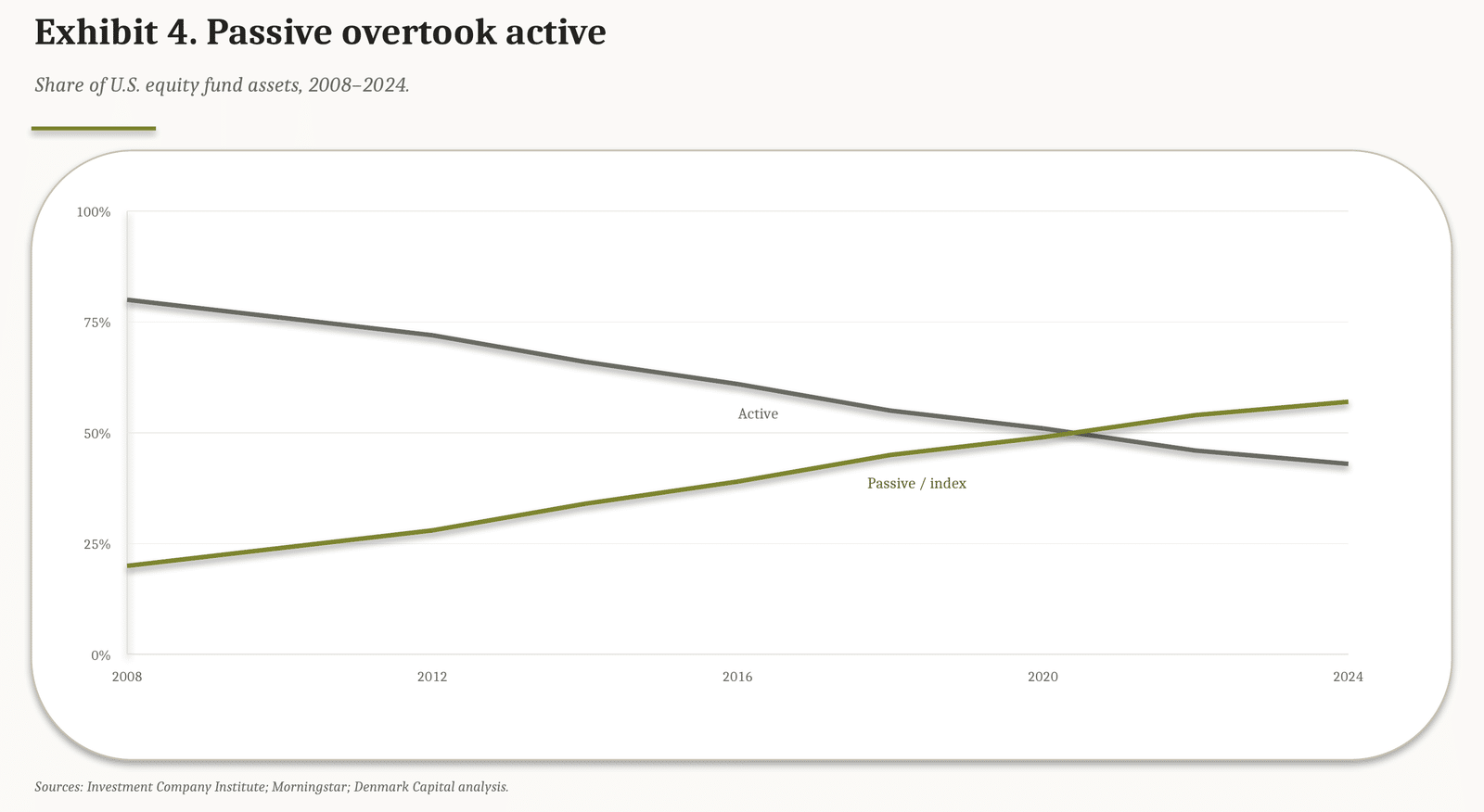
The first is passive. In 2024, for the first time, index funds crossed >50% of U.S. equity fund assets, up from ~36% in 2016, and passive vehicles overtook active in total assets for the first time in history. As many investors have noted, low-cost indexing is recommended to almost anyone who is not going to do the work. But consider what an index fund is as a market participant. It is a price-taker with no opinion. It buys a company because the company is in the index and because money came in, and it sells the same way, because money went out. Every dollar that moves from a thinking owner to a passive vehicle is a dollar subtracted from the pool of capital whose job is to assess whether a price makes sense.
The concentration of that price-taking is high. The three index giants, BlackRock, Vanguard, and State Street, together manage ~$25 trillion and are the largest shareholder in >85% of the companies in the S&P 500. The people who built these firms did the investing public a solid. By construction, though, this is capital that buys the great business and the doomed one in whatever weight the index assigns. When a company enters a major index, hundreds of billions of indexed dollars must buy it regardless of price. When it leaves, they must sell regardless of value. The marginal price is increasingly set by flows rather than by judgment about the business. True, valuation sensitive investors still set the price in most companies on most days. The argument here is about the tails, the stretches when flows overwhelm judgment, which is where returns can be decided.
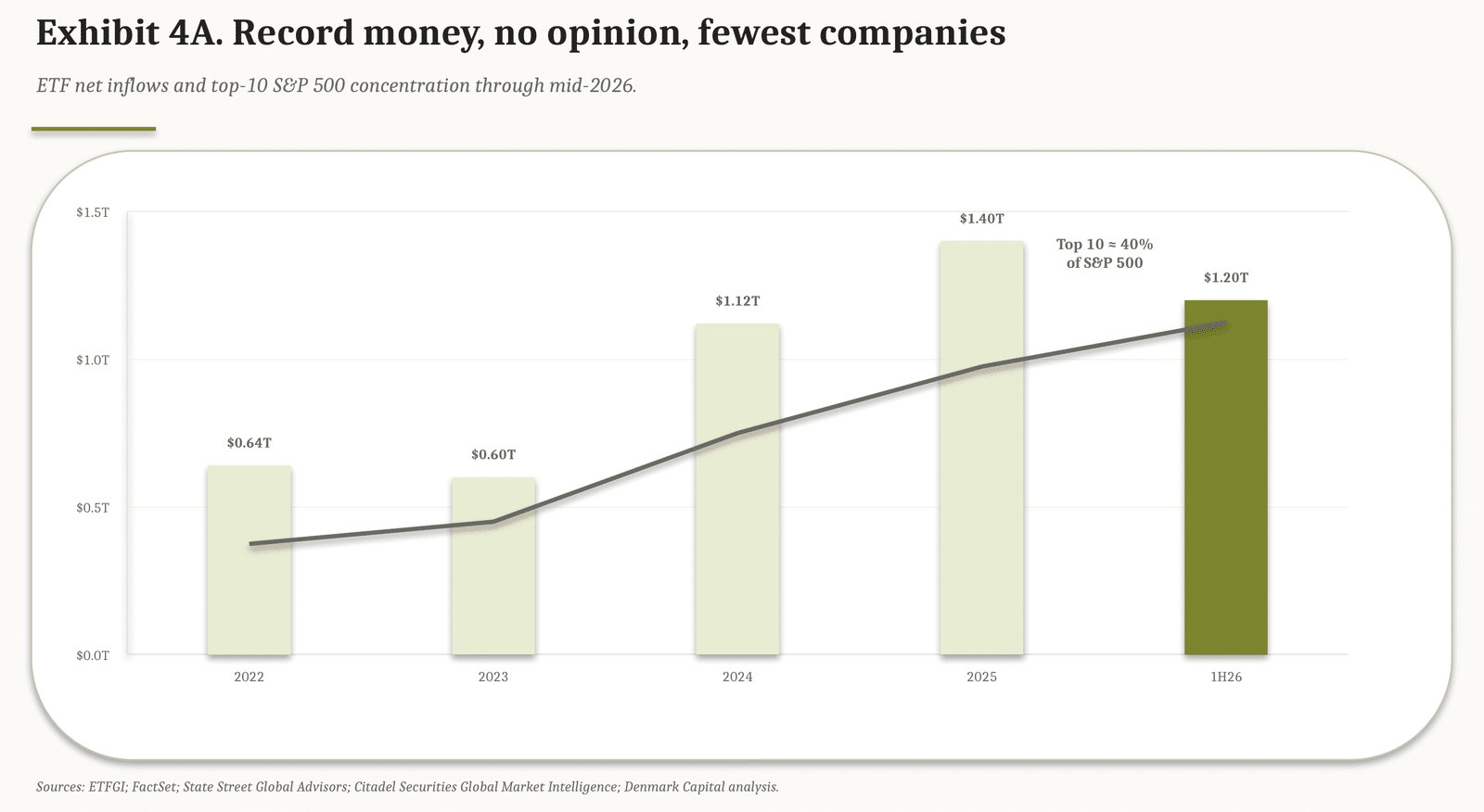
The flows are accelerating and into the most concentrated index of the last many years. In the first six months of 2026 alone, exchange traded funds took in ~$1.2 trillion of net new money, running ~45% ahead of last year’s record pace. And the buying goes across fewer companies. The 10 largest companies now make up almost 40% of the S&P 500, up ~10 percentage points in three years, and semiconductors alone are approaching 20% of the index, a share that has quadrupled since 2020. Record money, no opinion, fewest companies. This is the base layer of today’s market structure.
The data is slowly catching up to what many practitioners have felt for years. In their study of the inelastic markets hypothesis, the economists Xavier Gabaix and Ralph Koijen estimate that $1 of flow into the equity market raises the aggregate value of that market by ~$5. Today’s markets, in other words, magnify flows rather than absorb them. Their multiplier is an estimate, with a published range of ~3x to 8x. The reason is the structure just described: when the marginal holders are index funds and mandate-bound institutions that cannot flex their equity allocation in response to price, there are fewer participants left whose job is to lean against a move. This means prices often must travel a longer way to clear. A market that behaves this way often overshoots, in both directions.
The second foundation is speed. As far back as 2017, JPMorgan estimated that fundamental discretionary traders, humans buying and selling on the merits of a business, accounted for the substantial minority of trading volume. Today, it is estimated to be only ~10%, with passive, quant and other strategies whose ultimate decisions are not intrinsic value-based making up the rest. A key institutional development of the last decade has been the multi-strategy pod shop. Firms such as Citadel, Millennium, Point72, and Balyasny that spread capital across hundreds of tightly risk-managed teams. Multi-strat assets passed $430 billion in 2025, having grown ~175% since 2017 while the broader hedge-fund industry grew ~13%.
Two facts give the pods an even larger footprint. The first is leverage. By certain prime-broker estimates, industry gross leverage has climbed from ~4x a decade ago to double-digits today, so a few hundred billion dollars of capital can mean a market footprint in the trillions, and by late 2025 prime-brokerage leverage sat near the highest levels these firms had reported. The crowding now shows up in the price of leverage. In the first half of 2026, one-month equity financing spreads reached >125 basis points over the funding rate, because the demand to lever the same handful of stocks was so high. The second is reach. No public figures exist for a private strategy’s share of trading, but prime-brokerage and industry estimates put the pods at a large and rising share of daily U.S. equity trading volume, on the order of a third by some accounts. These have been highly successful organizations staffed by smart people, and many of their pods run fundamental analysts doing good, fundamental work. But the system those analysts work within is governed by risk limits, factor neutrality, and drawdown control, and 3-5 year views of free cash flow per share are not going to survive run-ins with those constraints.
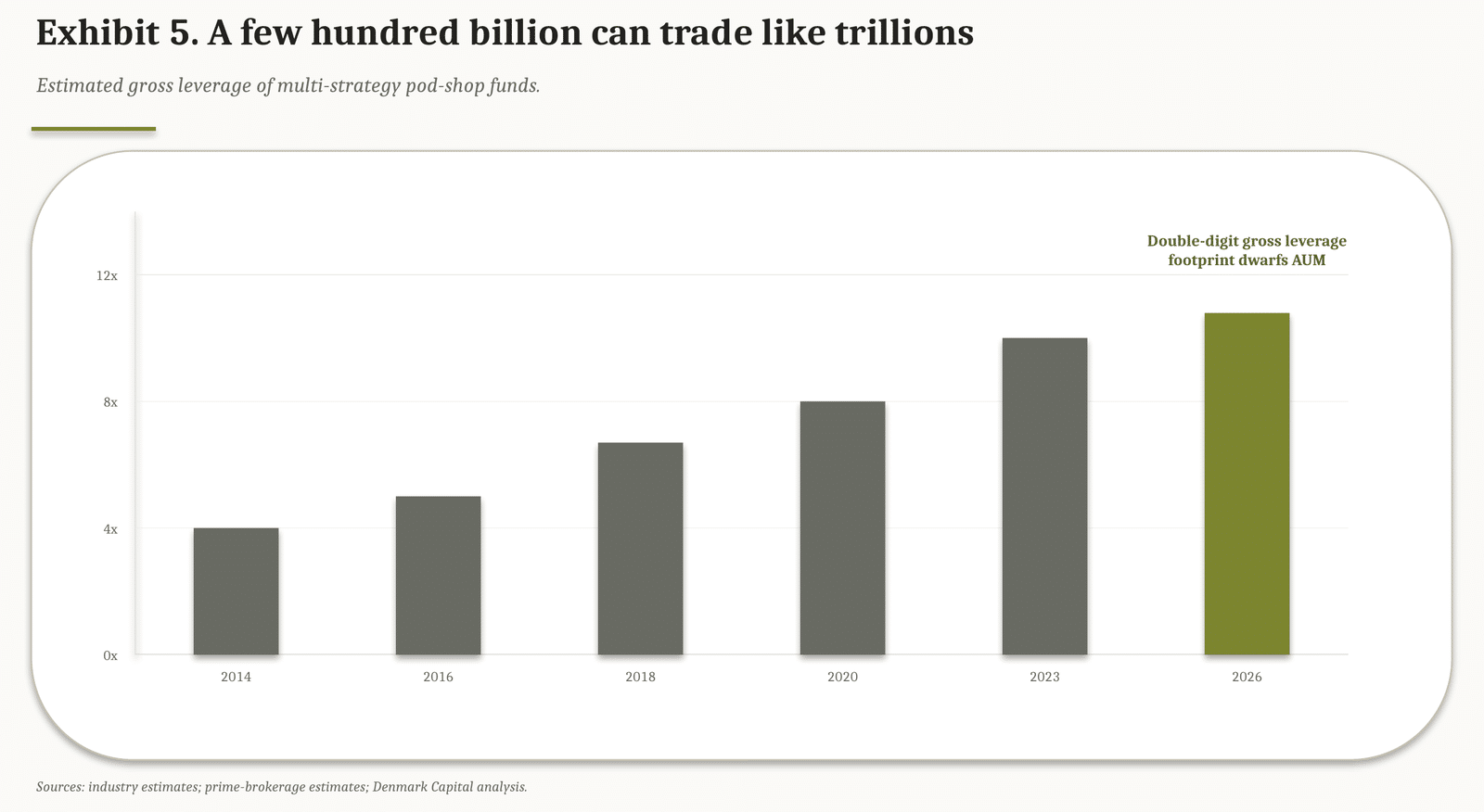
This leads to mechanical issues. A pod that draws down a few percent is cut. A position that breaches a volatility band is trimmed regardless of whether the fundamental thesis improved. And a pod that is stopped out liquidates the book wholesale. In one ugly week in early 2025, this kind of synchronized de-grossing rippled across the industry, and fundamentally fine businesses fell for no reason other than crowding. The daily trading that results is, in aggregate, a machine for converting short-term price moves into more short-term price moves. Weighing a business against its long-term worth is not what this machine is built to do.
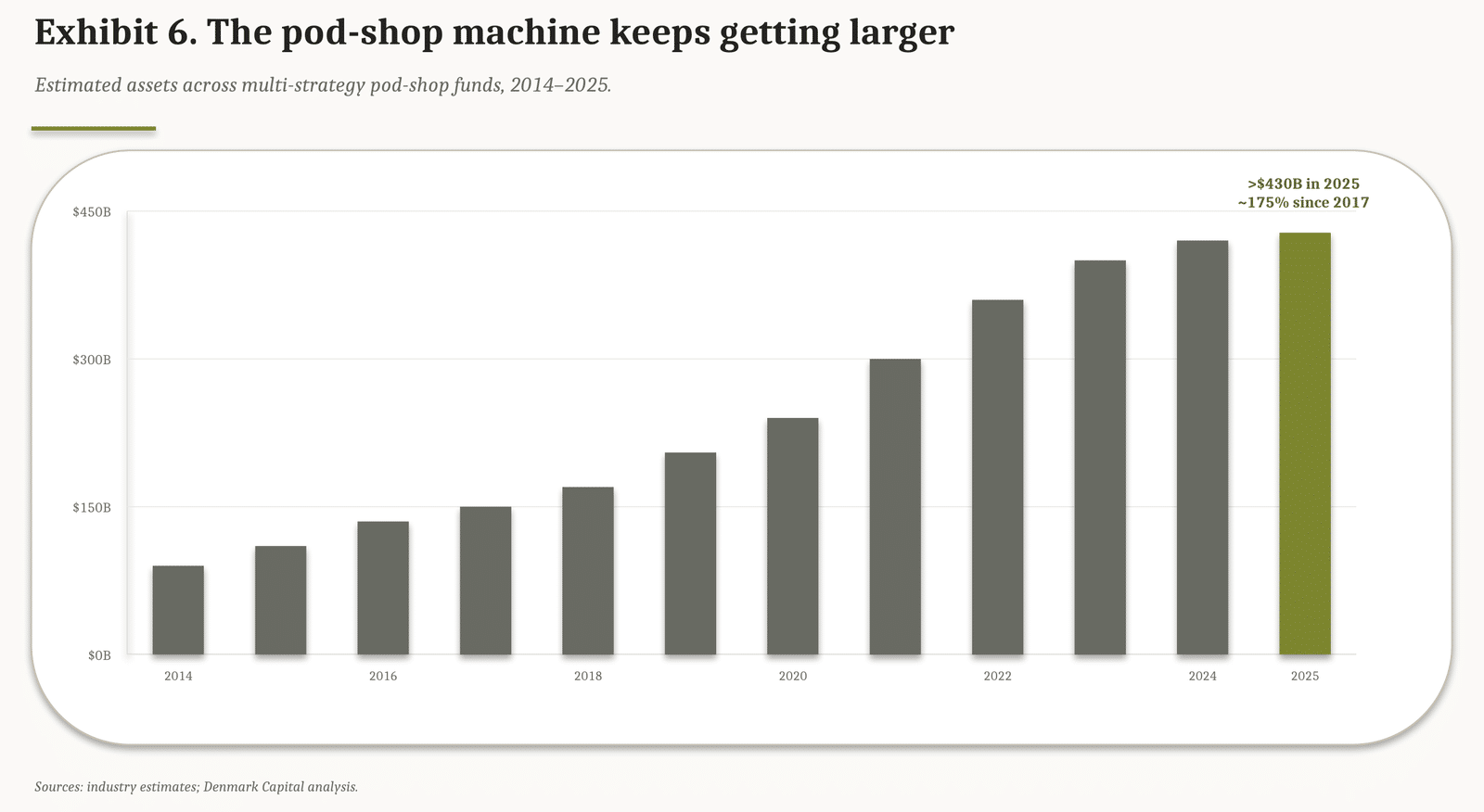
The third force is newer. The individual investor is back, at record scale, and behaving differently than prior retail cycles. Citadel Securities, the market maker that executes ~1/3 of all U.S. retail volume, reported that May and June 2026 broke every activity record it keeps. Daily retail volumes ran ~65% above 2025 levels and >2x 2024, nine of its 10 most active retail trading days occurred within those two months, and June 12 was the largest day of retail net buying it has measured.
Retail has become a structural bid. On days the index fell during the first half of 2026, retail bought at ~3.5x its daily average, the strongest dip-buying on record, and it kept buying at 1.5x the average even while the market rallied. Today, retail concentrates in the same leadership as the index, with semiconductors the favored sector currently. ~$1.9 billion of semiconductor options premium changed hands per day in June, 6x the historical average, 3/4 of it in call options. And the positioning is generally very short-term. One of every three listed options in the U.S. now expires the same day it is traded. ~50% of all retail options volume is in these same-day contracts, up from ~13% in 2021, and the average retail option now expires in less than three days. Leveraged ETFs hold a record $200+ billion, up ~60% since the end of March alone, concentrated in tech and semiconductor products. A bid that buys the dips reflexively isn’t really assessing whether the dip is deserved, any more than the index fund above it is. It is another layer of flow, levered and short-dated, operating largely within the same small group of companies.
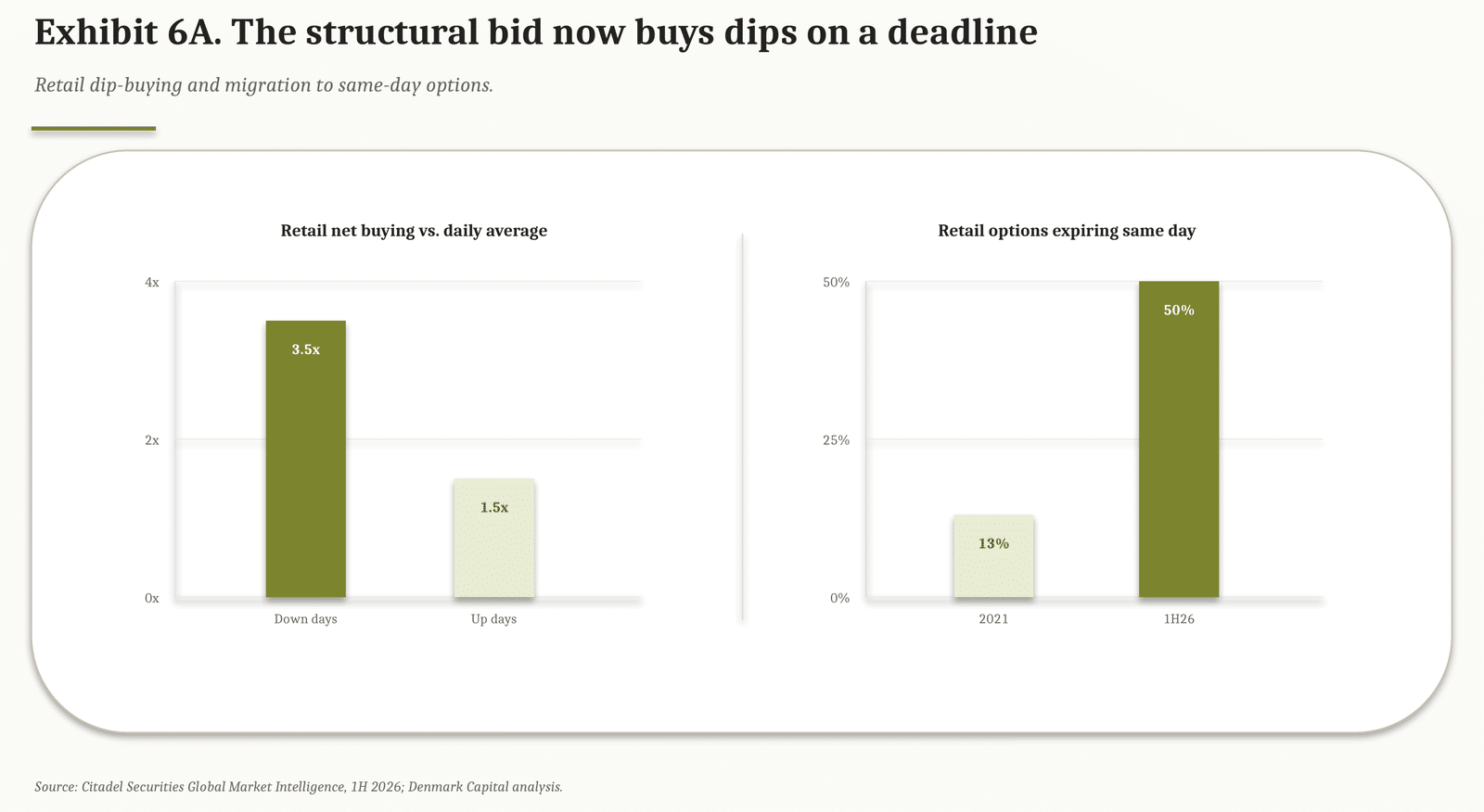
For a fundamental owner, the retail bid cuts in two directions, and both are important for this essay. It can compress shallow dislocations: when the fear is viewed as mild, the dip gets bought in days, sometimes hours, before any deliberate process can act. And it can deepen the severe dips: when a fear becomes strong enough to overwhelm the bid, the unwind can include leveraged holders and expiring options, or forced sellers, and the move can run further and faster than the fundamentals would justify. Fewer medium-sized mispricings, more small mispricings, and more violent mispricings. The market is now structured, layer by layer, to overshoot.
There is a subtler dynamic that has aided market structure moving so far in this direction and helps explain why it is likely to persist. The incentive in asset management is to gather assets, and the easiest way to gather assets is to sound complex, specialized, or systematic. Pitch an army of analysts and a proprietary algo rather than the plain sentence “we think unusually well about a few great businesses.” The first pitch raises billions while the second earns polite nods. So capable people build the thing that has product-market fit, and the market structure changes who builds and what they build. It has starved the most powerful form of fundamental investing of both talent and capital at the moment that form has become most valuable.
Taken together, no one can measure the exact mix, but the direction is not in dispute. A very large share of daily volume now comes from participants, passive, quant, volatility targeting, risk-limited pods, and a levered structural retail bid, who are not primarily expressing a view about what a business will be worth in 5-7 years. The fundamental, long-horizon owner has become the marginal exception more often than the marginal price-setter.
Then comes the accelerant. The foundations above were slow, forming over 20 years. This AI accelerant is being bolted on now and supplies the fuel that this new machine is built to amplify. Frontier models wired into agents are arriving faster than we expected, and they hand the short-term market an almost endless stream of plausible and, in the moment, unfalsifiable stories and posts about which companies AI will lift and which it will bury. A passive market has no opinion with which to push back. A systematic market has no horizon over which the story could be tested. A retail crowd trading 3-day options isn’t prepared to wait for the answer. So the story moves the price, and the price move becomes its own evidence. When a continuous narrative generator is dropped into the most narrative sensitive market structure built to date, the two multiply into something that is the subject of the next part.
◆ PART III
The volatility
When a market becomes more mechanical and less patient at the same moment it is hit with an endless supply of unanswerable stories, you get a market that swings hard in both directions, more often, across more companies, with less connection to what the underlying businesses are doing. The data is getting stronger.
Let’s start at the index level. In 2022, the S&P 500 moved >1% on 122 trading days, nearly half of all sessions, ~15x more often than in the placid market of 2017. 2025 included a stretch in the spring when the index swung several percent a day for weeks on tariff headlines alone, and 2026 has so far been at least as turbulent. The index actually understates the damage because averaging can mask individual stock moves that can be quite large. It is at the company level, where I spend my time, that the damage is largest.
Consider what now happens to a great business on the day it reports earnings. The average absolute earnings day move for an S&P 500 company reached ~5% in 2024, against a long-run average closer to 3%. Heading into 2025 the options market implied the largest earnings day moves in 15 years, ~5% for the median company and ~6% for tech. NVIDIA, by some measures the most important company in the world, now averages a move of >8% on the day it reports. When the 2026 figures are tallied, I expect them to be higher still.
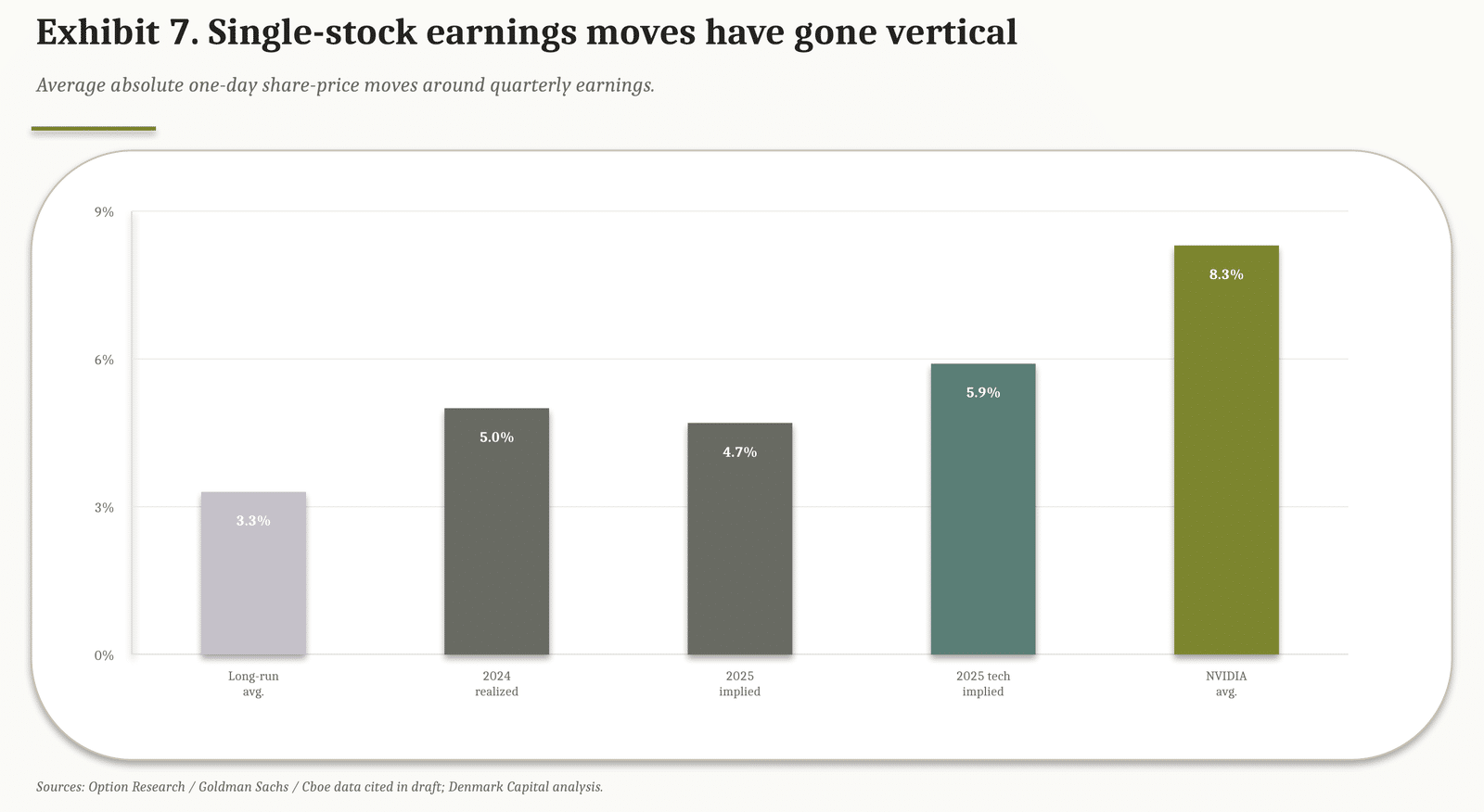
An earnings release contains information and expectations, discount rates, and uncertainty can move with it. The question is whether the size of the move is appropriate based on the size of the news, and for several of the largest, most widely covered businesses, quarter after quarter, it does not. What moved was the market’s guess about where that company sits in the AI hierarchy or how much juice is left in the growth opportunity, repriced as new information hits a market with little patience to absorb it. And between earnings, when less data exists to anchor anyone, the narrative roams free. The somewhat counterintuitive part is that the absence of fundamental data does not settle the market down. With nothing to anchor to, there is more guesswork, day by day, on whether a company’s next classification will be winner or loser, and whether AI will continually progress or fall short of expectations. Those questions have no near-term answer. So they get asked, priced, and re-priced, day to day.
An entire industry was born and has flourished to fill the space between earnings. Live data providers sell credit card data, app download data, web traffic data, and satellite feeds, each a partial and noisy proxy for a trend that will not be confirmed for weeks. A singular reading from one of these data providers can quickly move a stock 10%. Layer on a post or research note that re-sorts the winners and losers, a viral product demo, a screenshot of a competitor’s roadmap, and a dealer hedging a large options position into expiry, and you have a market that manufactures conviction out of fragments and trades on it aggressively, in the absence of the thing that could settle the question, which is the company’s own results. There has never been more information in this market, and never less understanding attached to it. That is why narratives spread so fast and reverse so hard. A story built on fragments is a story the next fragment can overturn.
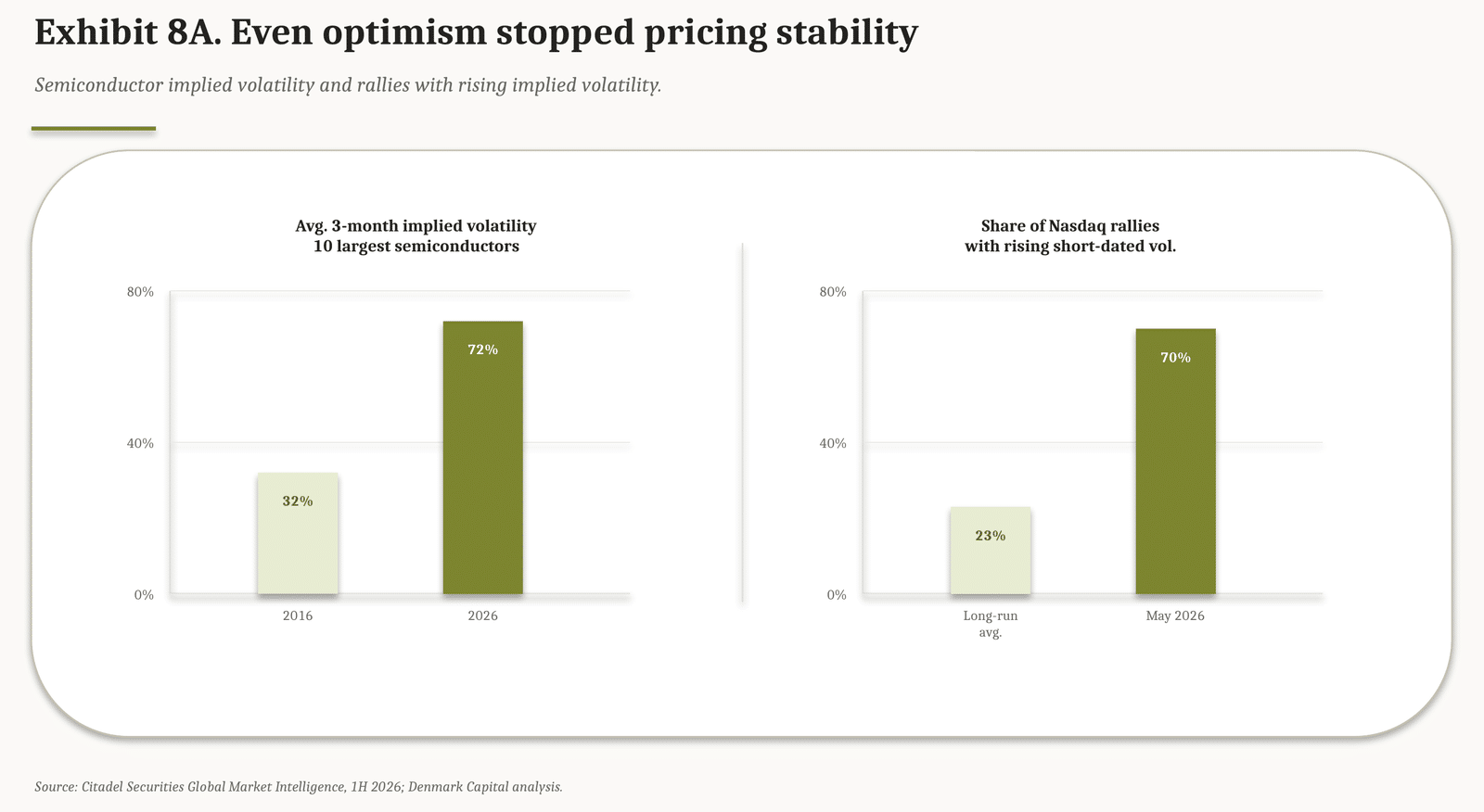
The options market has begun to describe this regime. The numbers, published by Citadel Securities’ market structure team in its public first-half 2026 review, are helpful here. The average 3-month implied volatility of the 10 largest semiconductor companies has more than doubled in a decade, from ~32% in 2016 to nearly 72% today, and this is the group that now leads the index. Dispersion among individual stocks swung from its highest historical percentile to its lowest within ~60 trading days this spring. Strangest of all, the market now pays up for volatility while it rallies. ~70% of Nasdaq rallies in May came with rising short-dated implied volatility, >3x the long-run frequency and the highest since 2005, and by the end of May >50% of the companies in the S&P 500 showed inverted call skew, meaning investors were paying a premium for exposure to further upside rather than for protection against a drawdown. A market that buys volatility on the way up expects to be surprised in both directions.
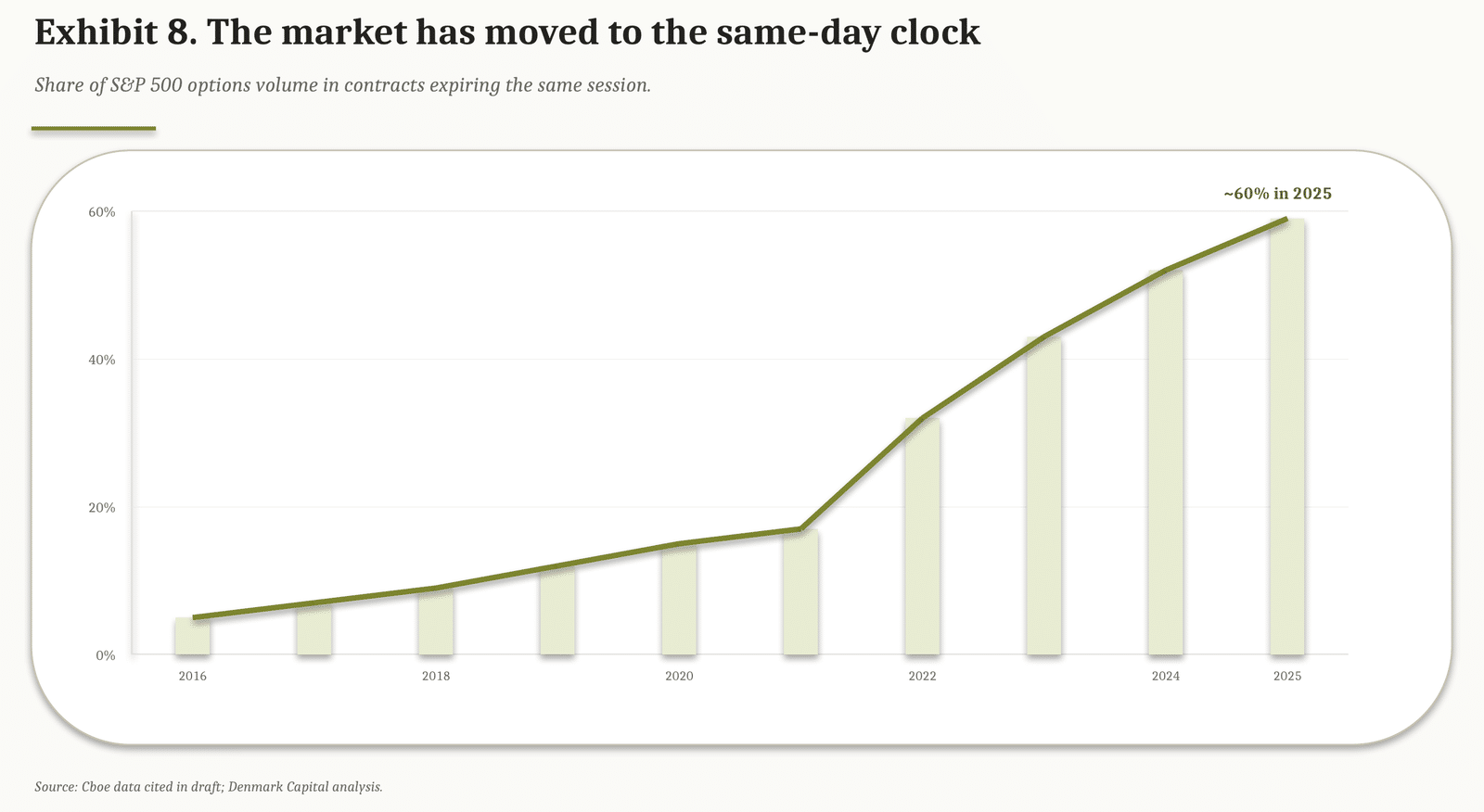
The machine reveals itself further when looking at when the trading happens. The market close has become a main event, becoming one of the largest liquidity events of the day, because this is when index funds and ETFs reconcile their flows to the official price. It runs around a tenth of daily volume on an ordinary session and meaningfully more on rebalance days. On June 26, 2026, the day FTSE Russell reconstituted its indexes and the highest volume session of the U.S. trading year, the final half hour ran >200% above a normal June day as hundreds of billions of dollars repositioned in minutes, none of it expressing a view about any business.
It hits individual companies on no news. That same afternoon, Perimeter Solutions, a specialty fire retardant business with nothing whatsoever to report, fell ~7% in the final 10 minutes, caught in mechanical repositioning that had nothing to do with the company’s contracts, its fire season, or its cash flows. Smaller versions happen constantly, and the derivatives have gone the same way. Same-day options are now ~60% of S&P 500 index option volume and one of every three listed options across the whole market, up from a low percentage 10 years ago, and on a slow news day that flow alone can move the index.
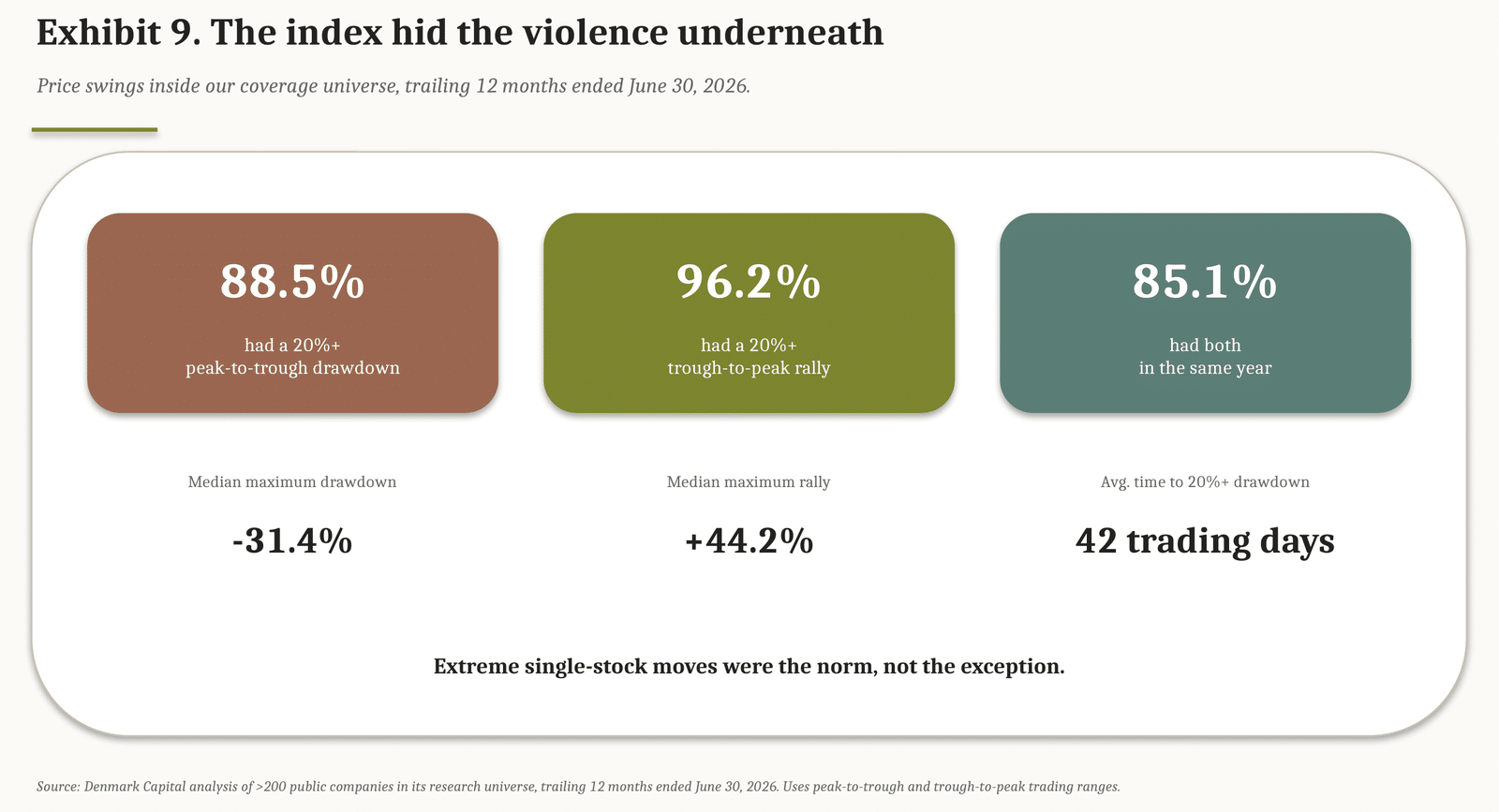
I see this because this is where I spend my days. It has become routine for more than 3/4 of the companies we follow most closely to move 2%+ on a given day, up or down, with no company-specific, performance-based news at all. Information arrives faster and in greater volume than at any point in history, which means the stories surface and swirl for weeks before they can be tested against real results. Based on internal data over the last 12 months, across our research coverage universe of >250 companies, the median maximum drawdown has been >30%, the average time to drawdowns of 20%+ compressed to just 42 trading days, and ~85% of the cohort experienced both a 20%+ drawdown and a 20%+ rally within the same 1-year period.
Most market participants cannot use any of this because they are not built, in temperament or in structure, to endure it. The pod is cut at a modest drawdown. The passive vehicle doesn’t have a view. The volatility targeting fund sells into weakness by design. The large long-only gets repeated shoulder taps from clients that often have conflicting mandates. The retail bid can reverse the moment the losses on 3-day options start to compound. The entire system is engineered to jump all-in or all-out. Every jump by a pressured seller is a price moved further from value. You almost need to thrive on pain to embrace it, and then each of those jumping can be viewed as a counterparty handing you a better entry. The volatility that is a liability for most is the raw material of a permanent owner who has done the work and can be patient.
There is nuance though, and the definition of patience needs to be revisited in this new regime. Charlie Munger said that an investor unwilling to respond with equanimity to “a market price decline of 50% two or three times a century” deserves the mediocre result he is going to get. He was right, and he was describing a different market. The declines he had in mind arrived a few times in an investing lifetime and were driven by recessions, panics, and wars. That still happens, but today’s market can produce large drawdowns in individual stocks more frequently, driven by nothing more substantial than a post that takes hold and a quarter or two of results that disappoint market expectations while the debate ignites. And because AI has hung a question over the terminal value of multiple industries at once, these narrative drawdowns no longer arrive one company at a time. They arrive in cohorts. Salesforce and Workday did not each lose a third of their value alone; the label fell on the whole enterprise software industry. So patience cannot mean passivity around large positions under this type of market structure, and it cannot mean trading based on feel either. The machine is better at trading than any human, and dancing in and out of it without predefined triggers converts a structural edge into a game the machine almost always wins.
Patience should now mean owning the business for years while it compounds and the price still makes sense, and work to avoid being at or near your maximum size through the stretches when the market is gearing up to fight you. When the conclusion from your work is that you see a protracted narrative or a fear forming early enough to act on, before the debate has run its course, you avoid being run over while it runs, and you can become a larger shareholder at the point of maximum flinch, or when the fear more clearly dissipates. Slow-clock ownership is the willingness to hold as a real position through the storm, acknowledging the magnitude and duration of the storm are always unclear, joined to the discipline of having decided, before the storm has been fully unleashed, to size your position small enough to mitigate more of the painful single stock drawdowns that today’s market structure produces routinely. The next part is about the importance of telling a real storm from a temporary issue, and about the type of sizing model that allows for slow clock ownership while acknowledging today’s fast clock.
◆ PART IV
Telling a dislocation from a deterioration
There are two lines. The first is the value of a great business, climbing the slow clock. It is steep at first, then relentless, even boring as free cash flow per share compounds over time. The second is the price of that same business. It behaves like the output of the machine discussed in the last two parts: flows, factors, rates, crowding, posts, headlines, quarterly revisions, and now AI narratives stacked on top of it. Today the second line swings far above and far below the first line, more often, around the same types of companies.
Asking whether the market is efficient leads to never-ending debate. But ask which clock it is efficient on and the picture resolves. Today’s market might be considered largely efficient on the fast clock, processing flows, positioning, and headlines in seconds, but is increasingly inefficient on the slow one, where business value accrues. Active versus passive was the last era’s debate. Clock mismatch is the main thing now: prices set by participants running clocks measured in days, on businesses whose questions resolve over years.
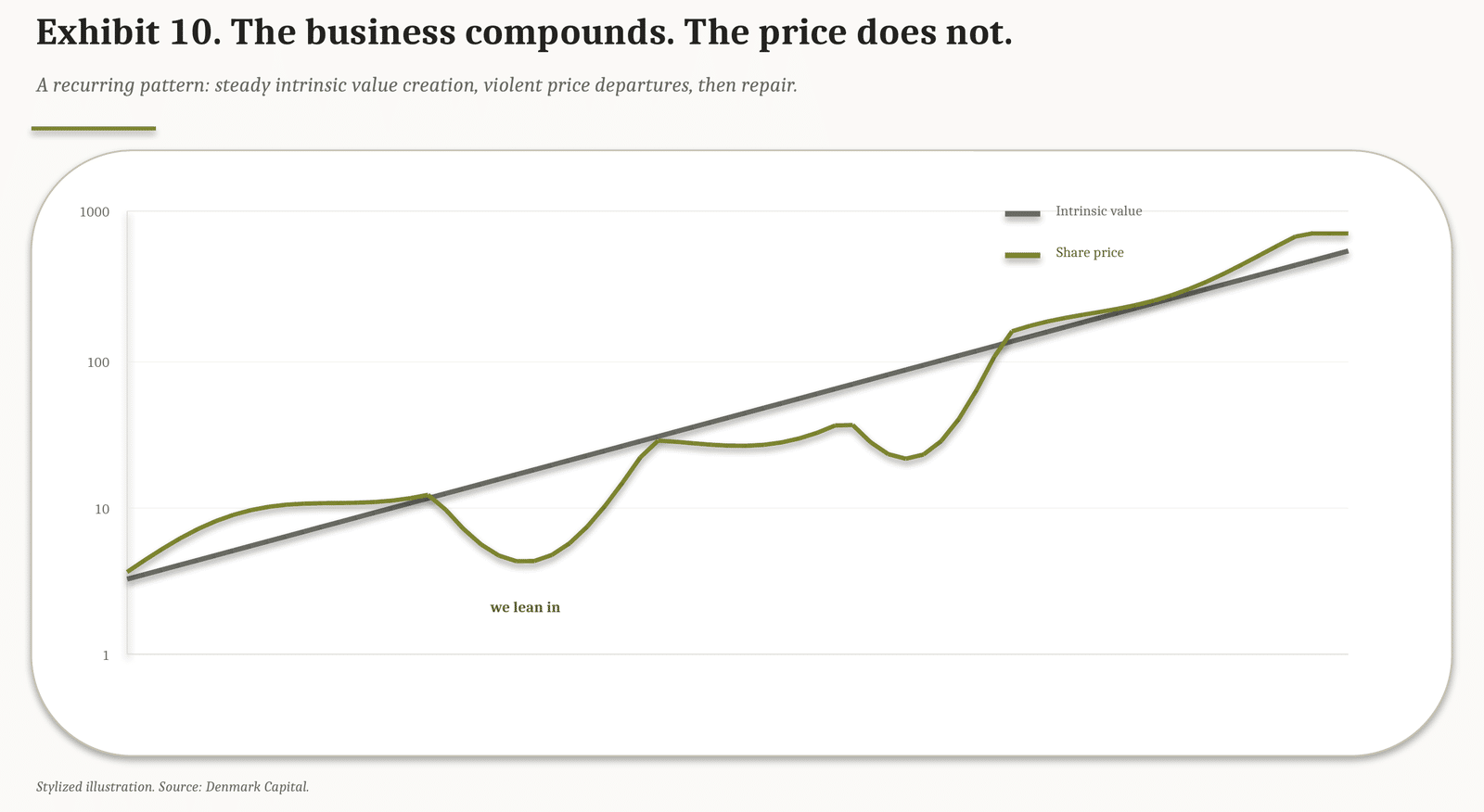
For a fundamental owner, the space between those two lines is the opportunity. When price swings far below value, you are being handed one of the best businesses on the planet, or one you have concluded is going there, at a discount created by the structure of the market. The volatility that the marginal participant cannot endure becomes, to a prepared owner who has the capacity to suffer, a steadier flow of chances to buy, though more often now they are chances that demand a faster decision, with the same companies cycling through multiple dislocations.
The rest of this part is the Two-Clock Test from the opening pages applied to actual companies, because the danger is that a falling price is often for good reason. Most publicly-listed companies are average-to-poor when looking at data points like market share and trajectory and various indicators like returns on capital employed. So many of them are, in fact, in the process of melting and being impaired, by AI or something more ordinary. The skill, learned over years but always hard and frequently humbling, is telling the two apart with enough consistency to win. I think about it the way a physicist thinks about a complicated system. You do not stare at the scary headline as one fact or view the inherent uncertainty of the future as paralyzing. You go from business to business and decompose them into the key elements that govern them: competitive advantage, value proposition, unit economics, the size and growth of the market, leadership, reinvestment, returns on capital, the balance sheet, and the handful of things that could disrupt it. Each of those elements has observable indicators. Each indicator has a level at which the thesis would fail. You do not ignore the fear, uncertainty and doubt, but you stay focused on applying the analysis and logic the fear can get in the way of.
That is how the largest positions get built, almost always in the middle of what you conclude to be a big dislocation. In 2022 the market told a scary story about Meta: advertising impaired by Apple’s privacy changes, attention shifting to TikTok, $10 billion a year set on fire in the metaverse, and a founder more interested in his legacy than in his shareholders. The stock fell >70%. Decomposed, the Apple headwind was a quantified number attached to a credible engineering response. The TikTok fear was a measurable question about attention share with a product answer in Reels. The capital allocation worry was fair, and it was attached to a $40 billion core profit engine and a new CFO’s willingness to impose more discipline. From its late-2022 low the stock has since risen many times over. Netflix that same year offered a similar lesson. A couple of soft subscriber quarters reframed it from streaming champion to secular loser, while the indicator that mattered most, viewing share in original TV series, held steady, and two repair levers, paid sharing and advertising, were in motion. The market priced the narrative while the decomposition priced the business, and the return was in the space between the two.
Meta is also where the sizing discipline described later in this part was reinforced, twice. In March 2018, in the strategy I then co-managed, the Cambridge Analytica scandal broke. I reached the right conclusions about the business: social media would produce a steady flow of negative consequences, but the companies that acknowledged them early enough and attacked them aggressively would be positioned to retain their networks. I also judged the stock already cheap against intrinsic value, so I stayed full size. Both judgments proved correct, and the sizing was still wrong. The controversy had quarters left to hit, sentiment had nowhere to go but against the company, and the stock went on to fall >40% from its peak that year, faster than I expected. My post-mortem was that I did not need to be standing there at full size. I could have carried Meta at the lower end of its core range and bought the decline instead of absorbing it. Then 2022 arrived, a hurricane of headwinds hit a stock already well off its highs, and I held it as a large position on the same logic, that it was already cheap. It was, and I still ate a decline of ~70%, with a post-mortem that showed opportunity after opportunity to trim along the way and rebuild lower. The thesis survived both situations, but the sizing did not. When you learn the same lesson twice, the problem is the process. Timeliness and controversy magnitude and duration now play a role in sizing, because cheap was never the question in either situation; the question was how much of the portfolio should have been exposed, and I lacked a disciplined way to answer it. The AI era, which manufactures these types of storms more often and more violently, is what pushes that model from useful to mandatory.
A company like Adobe is a different type of example, the plausible disruption that keeps the method disciplined. Adobe has exceptional products, deep creative expertise, brand trust, and the ability to integrate its own and third-party AI into Photoshop and other products. In many professional workflows AI will make those tools more valuable. But the barriers AI lowers are more dangerous when a product does not own all of the things that make a platform hard to displace: deeply embedded workflows, proprietary or controlled data, a powerful distribution layer, an ecosystem of developers building on top, and domain and business logic expertise that AI-native competitors should struggle to reproduce. Much of Adobe sits close to the creation layer. If models can produce good enough images, layouts, videos, and campaign variants inside Canva, Figma, a native model interface, or an enterprise agent, then the question is whether some portion of Adobe’s historical pricing power, seat expansion, and margin structure still deserves the old terminal assumptions. That is a harder AI question. There are many ways it could prove manageable. But it is enough to land in the too hard pile. The answer cannot be “buy all companies the market has labeled a loser.” The answer is decomposition, company by company. Where AI clearly weakens the business physics, lower the conviction. Where AI changes the interface but leaves the harder system intact, be ready for the market to confuse a new surface with a broken foundation.
The companies discussed in this part, DoorDash among them, illustrate an analytical process. They are not recommendations. See the notices at the end of this essay.
DoorDash illustrates the second category, a business whose stock has been punished more than its reported results can explain under today’s market structure. Two fears have converged on it. The first is the agent question: if a conversational AI becomes the user interface for ordering, does the marketplace get disintermediated, its interface reduced to something an agent shops across? The second is older and more familiar. On its late-2025 call, management confirmed an investment year, ~$500 million of incremental 2026 spend to rebuild its tech stack after the Wolt and Deliveroo acquisitions, which revived a recurring anxiety about whether founder-CEO Tony Xu is a disciplined steward of capital, particularly within markets that remain early and competitive. Put the two together and the stock fell ~40% from its highs even as the business kept compounding, to a multiple that implies a high probability that the business model is broken.
When decomposing, the agent fear treats DoorDash as a front-end. We see a three-sided network with ~60% of U.S. food delivery share, >8 million couriers, and over a million merchants, orchestrating onboarding, merchandising, routing, fulfillment, and support across billions of orders. Active users have grown from ~10 million in 2019 to >55 million. Orders went from 263 million in 2019 to >3 billion in 2025. The company now generates ~$2 billion of free cash flow (growing quickly) in a market still lightly penetrated, since U.S. food delivery remains only a single-digit percentage of a food spend market above $2.5 trillion, before adding the rest of the world. The tell of underlying earnings power is in the company’s disclosures that the core U.S. restaurant business has run incremental operating margins above 7% for eight straight quarters. On this decomposition, the compounding engine is intact and deliberate investment is masking it. That is a falsifiable read: the incremental margins, order growth, and user growth above are where it would break. On the agent fear specifically, an agent changes the interface, but the delivery service still must happen. DoorDash is an early partner to the largest AI platforms, can build its own conversational experience where it has the right to win (see Ask DoorDash), and can choose the terms on which it integrates with third party agents. The agent still needs to hand the order to someone who can get hot food to a door in 30 minutes. DoorDash has spent a decade and billions of orders learning how.
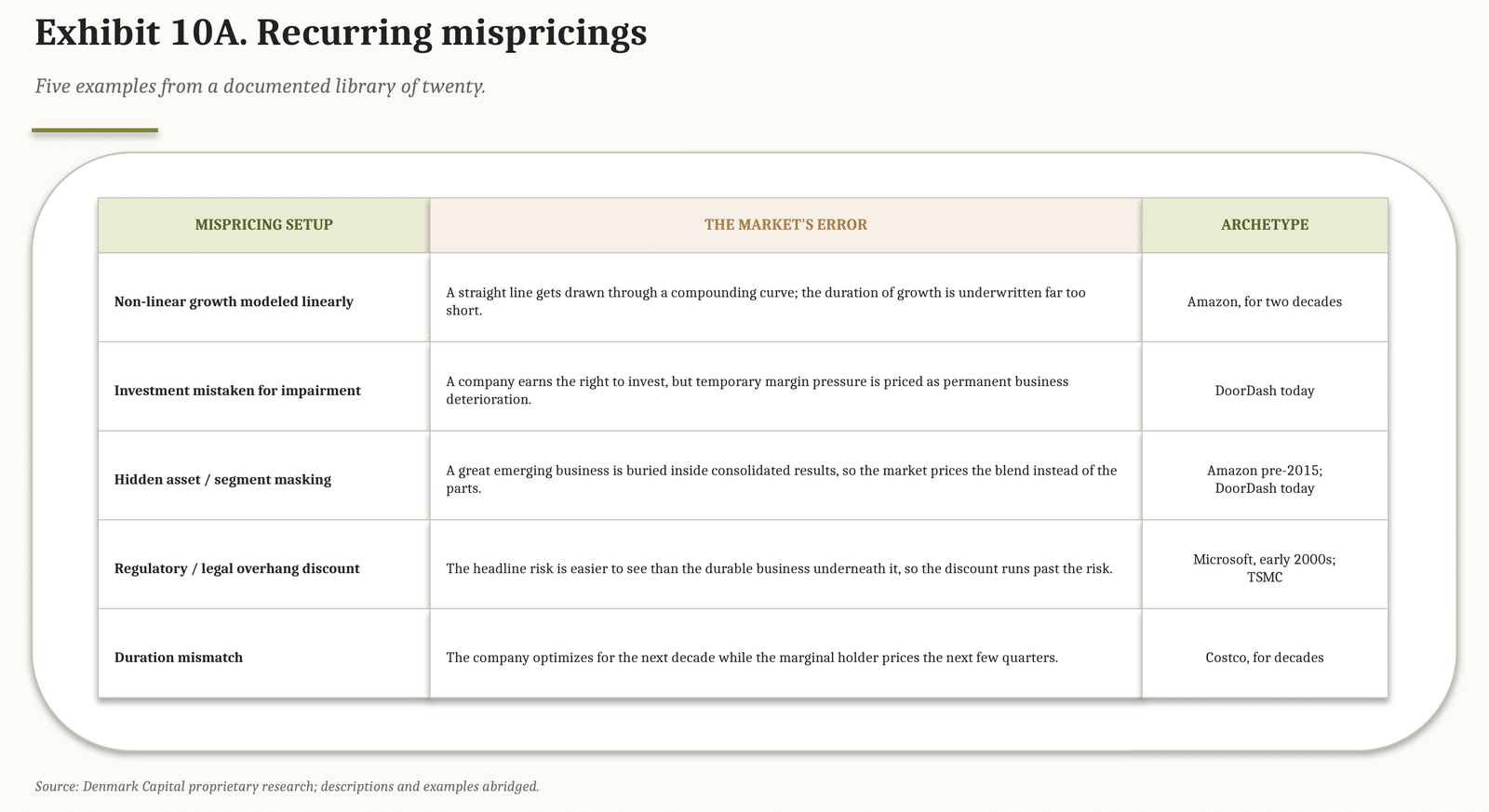
There are three recurring mispricing setups occurring at once here. The durable incumbent written off during a platform shift, core profitability masked by deliberate investment, and the good business sold alongside its entire “AI loser” cohort. What stands out is the pattern. The market has made this same family of mistakes many times before, around companies with rational operators, powerful distribution, embedded customer behavior, domain expertise, and investment periods it did not have the patience to underwrite. The discipline is learning to recognize the same mistake under different sets of facts and circumstances and keeping a documented map of them.
Investment mistaken for impairment, volatility mistaken for information, a temporary drought mistaken for exhaustion, a broken narrative mistaken for a broken business. On the first one, a company earns the right to invest, then enters a period when growth is no longer effortless or margins are temporarily ugly or a new technology creates terminal value fears. The stock falls, the multiple compresses further than the facts warrant, and the market treats investment as impairment. For the companies worth owning, one of two things ultimately happens: the new investments earn their return, or the rational operator pulls them back. In both cases the error was extrapolating something temporary into a permanence. UnitedHealth becomes, repeatedly, an emotional business, where regulation, medical cost pressure, public anger, and political scrutiny become too much to bear for those who are volatility averse. Thermo Fisher has a different pattern as a resilient, “sleepy” compounder repeatedly mistaken for exhausted whenever a temporary drought, post pandemic digestion, soft biotech funding, or weakness in China arrives. Different sectors, same underlying machine.
Seeing the dislocation, and even classifying it correctly, still leaves the question that decides outcomes: how big. This is where slow-clock ownership gets weighed. Every position needs to carry a conviction rating, and the score should be built from two kinds of factors that you’ve spent years shaping and evolving around your belief system. The first kind is about the business fundamentals and moves slowly: the strength and durability of the competitive advantage, the size and growth of the market, the rarity of the operators, the financial strength, the agility, the disclosure and transparency. Those factors play a large role in whether a company should be backed at all, and they are the primary reasons why a core position stays core even when the near-term looks weak.
The second kind of factor acknowledges market structure dynamics from Parts II and III. Timeliness: whether the next few quarters offer a gauntlet, and whether the market is gearing up to fight this company based on what you see. Controversy duration: when a company-specific controversy appears that you have identified, an investment year, a regulatory issue, a fresh “AI loser” label, the useful question is how long the narrative can rage before reported results are able to disprove it, because a fear that takes multiple quarters to falsify can lead to more share price carnage in this market than you would assume, as we have painfully learned many times over, no matter how good the work behind the position is. Variant perception on valuation: how far your appraisal of the business sits from the price, and how much of the prevailing fear the price has already paid for. We would argue these factors didn’t matter nearly as much even 5-7 years ago. Now they do.
These near-term factors do not put a company into the portfolio and do not take one out by themselves. They primarily govern weight. A deemed generational business carrying weak near-term factors stays owned, at a size that a 30-60% protracted narrative drawdown should prevent from becoming a big portfolio event, with capacity to buy that type of drawdown when it surfaces. A great business with strong fundamental factors, cheap based on your work, past the worst of its controversy, and with the debate becoming exhausted, is where the large positions should be built. We should not pretend this is timing in any precise sense. Bottoms are hard to catch with any skill, and this approach will involve carrying a smaller weight through storms that don’t show up or quickly resolve. The purpose is narrower: to build process so that when the market takes one of your companies down by a third or more on a story, the likelihood of standing at large size in front of it is reduced. That process element, more than any other, is what can let a concentrated portfolio hold a small group of companies straight through the market described in this essay. That is the refurbished slow clock: the same long-term ownership, re-geared for a market that makes it important to understand how the fast clock is moving.
The DoorDash work discussed above is an example here, too. We have followed and admired the business for years. When the agent narrative and the investment-year controversy began to form, the timeliness and controversy scores fell, and the model pulled the warranted weight well below where long-term conviction alone would have set it, with capacity reserved to buy the kind of drawdown this market manufactures more frequently. The views behind those scores update weekly; the weight moves when a score crosses a threshold. Staying engaged with a company through a storm like this one happens when the process keeps reaching the same two conclusions: the business is unusually well positioned for the long term, and our view of what it is worth has barely moved at all, even as the warranted weight has traveled. This separation, a stable view of intrinsic value underneath a moving weight, is the point of the framework.
The objection is that weights which can move within weeks or even days is trading, and this essay argues that trading is a lost game. The difference is in the goal and in what is being judged. A trader predicts the direction of short-term price with the intent of winning each trade, which we view as too hard to achieve with any consistency over long periods, and the machine should win that game. Here, it is instead designed to offer protection when weights are reduced and judge things that should be observable from your work: whether a controversy exists, when reported results will be able to test it, whether your variant perception has become stronger or weaker, how much fear the price has already paid for. A fear that cannot be falsified in the near-term is not a forecast; it is observed based on when information arrives. So the ownership decisions and the long-term value still move at the speed of the business, and only the distance between a weight and what the moment warrants might move quickly in this market. You change your mind about how much far more often than you change your mind about whether. The first is written into the process while the second is guarded from it. The holdings are patient; the weights are not allowed to be in a market regime like this one. The costs of that responsiveness are real, taxes, trading friction, and smaller weights through some storms that never come, and we pay them. In a market that can take 25%+ from a great company on a debate, that is the insurance premium. Meta (and others) priced the alternative for us more than once.
Without that framework, conviction is more likely to become stubbornness and cause portfolio damage more often given today’s market structure. With it, volatility becomes something you can better size against. The framework raises a more basic question, though: out of the tens of thousands of listed companies in the world, which ones are even worth this kind of obsession?
◆ PART V
All of it comes from almost none of them
There is a clear power law in public markets. It should govern where an equity investor spends a career. Nearly all of the wealth created in public equities comes from a tiny handful of companies. The rest, taken together, was a wash or worse.
Hendrik Bessembinder provided data that shows, in the U.S. since 1926, the best performing 4% of listed companies account for all of the net wealth creation of the stock market above Treasury bills. The other 96%, collectively, matched cash. The top 90 stocks, about three-tenths of 1% of the total, produced more than half of it. Five companies, ExxonMobil, Apple, Microsoft, General Electric, and IBM, account for about a tenth of all the wealth U.S. stocks have created. Globally, it is a lower percentage. From 1990 to 2020, only 1.5-2.5% of companies generated all of the net global wealth creation, while >50% of all stocks lost money outright. Only ~43% of U.S. stocks have beaten a one-month Treasury bill over their lifetimes.
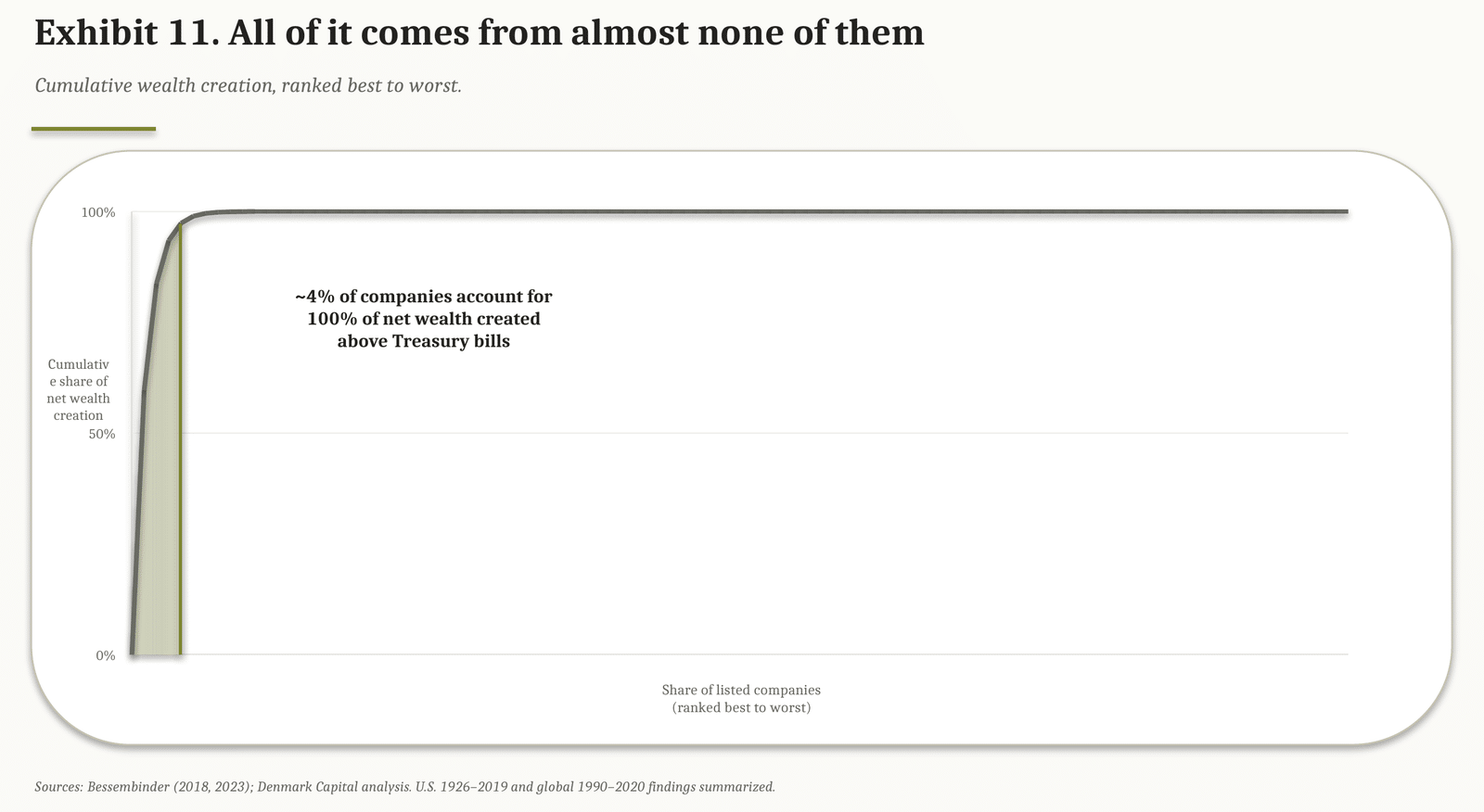
The most valuable thing an equity investor can do, the skill that has dwarfed the others to date, is to identify members of that 2-4%, with enough consistency, and to hold them, in some size with an eye towards advancing them to large size, through the storms while the compounding does its work.
There is an irony in the rise of passive. An index fund works because of the power law. It succeeds by owning the handful of big winners and letting them swamp the many losers it must also hold. This means the index holds the average, the failures, and everything in between alongside the few generational businesses, in whatever weight the market assigns, with no mechanism to move more heavily toward the winners or away from the weak. The growth of passive raises the value of actively pursuing the few because it strips out of the market the discernment the power law rewards. Note that even the derivatives market has pointed in this direction. Three-month implied correlations fell this spring to their lowest levels in >15 years, marking a period when single stock selection mattered. Bessembinder himself, whose data presents the argument for indexing, noted the rewards available to the investor who can identify these rare companies and hold them with skill and patience. Both things are true at once. Indexing is right for almost everyone. And because it is, the narrow skill of identifying the few and holding them through the fear has rarely been less crowded.
The volatility and periods of looking silly is the toll for that prize. The greatest businesses in history did not compound in a straight line. They compounded through some gut-wrenching drawdowns along the way that shook out everyone without the structure to hold on in some capacity. NVIDIA has fallen >50% on seven separate occasions since it went public. Apple has done it four or five times. Amazon lost ~90% of its value in the dot-com crash and fell hard again in 2022, on its way to becoming one of the greatest investments of the era. Drawdowns are the price of admission for superior long-term returns. The investor who cannot pay that price does not get the return. Someone else does. The discipline comes down to being able, in structure and temperament, to hold the right business, ideally at increasing size, when the market is most certain you are wrong, which is the moment today’s market produces more often.
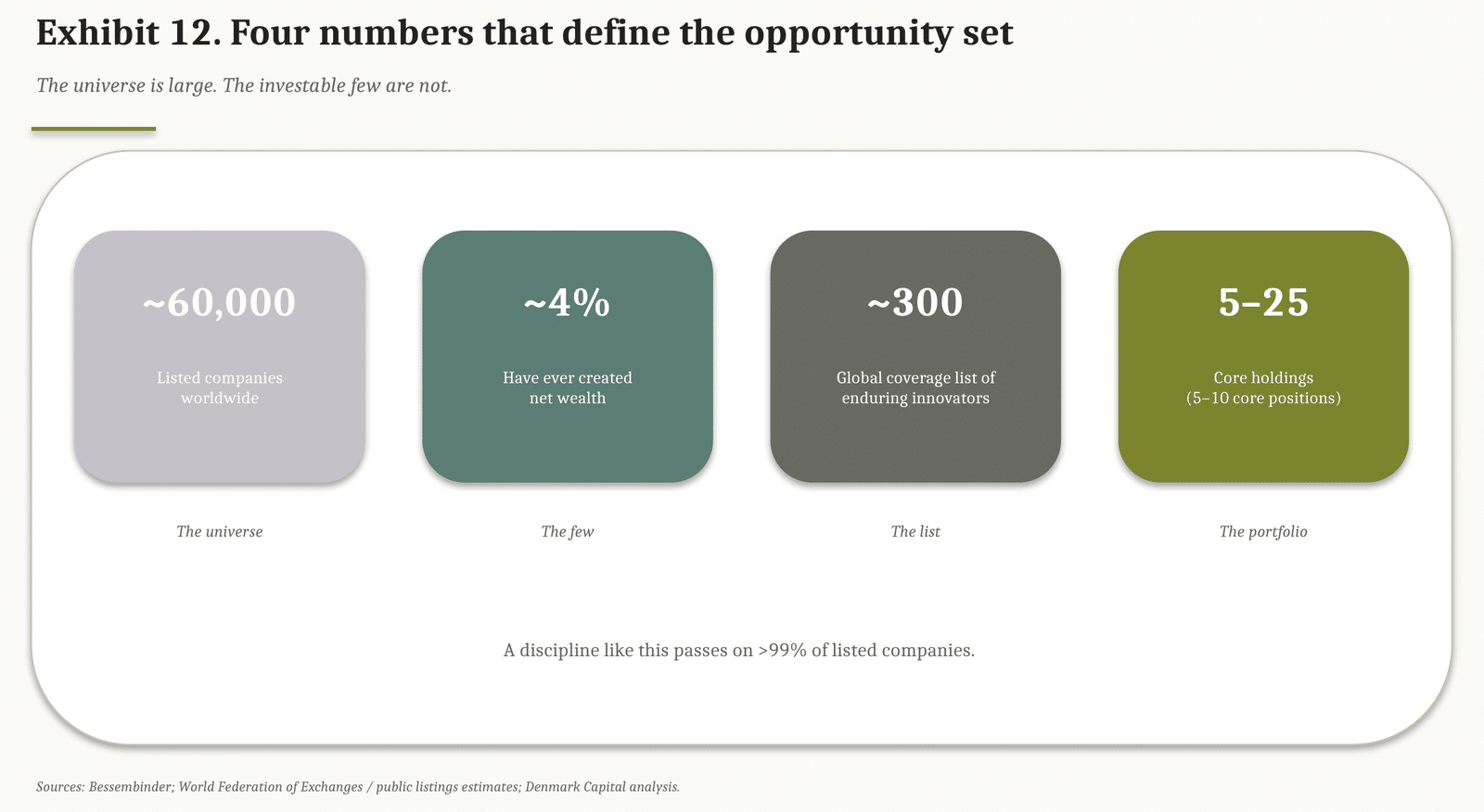
So the universe that deserves a career’s worth of obsessive attention narrows, out of nearly 60,000 publicly-listed companies, to a few hundred at any given time, globally, that share the traits every member of that 2-4% minority has possessed: competitive advantage in its strongest form, a large and expanding market, relentless product innovation, financial strength, and exceptional operators. The craft is the discipline to pass on >99% of what exists in order to stay close enough to those few, and to know them well enough that when the machine throws one of them away or otherwise underestimates them, you feel comfortable stepping in.
◆ PART VI
The specialty hiding in plain sight
The remaining question is who can act on this. The answer is a specific, rare, and badly misclassified group. They have been called generalists for their entire careers. They are nothing of the kind.
The industry defines a specialist by where they look: sector, region, company size. A semiconductor specialist, a biotech fund, a European mid-cap manager. The premise is that narrowing the field by geography or industry produces depth, and depth produces analytical edge. It is a reasonable premise, and inside those niches there are some really good investors. But it mismeasures the thing that drives returns. The value creation we just looked at was handed out by quality, not sector. It was driven by the rare traits that let a business compound for decades. Those traits have existed in software, healthcare, payments, consumer discretionary, and semiconductors, and in the U.S., Brazil, and Taiwan.
There is a different axis of specialization. It is defined by what you are looking for rather than where you look. It sits at the intersection of strongest form competitive advantage, a large and growing market, operational excellence, and a deep, documented understanding of the mispricings that recur around exactly these businesses. Call the people who dedicate their careers to it mispriced-compounder specialists. They keep a coverage universe of a few hundred companies, often smaller than a sector fund’s and pass on the remainder quickly. That is at least as narrow a filter as any niche. It is a quality and mispricing filter rather than an industry filter, and it takes tens of thousands of hours and hundreds of company reps across cycles to build the heuristics and pattern recognition it requires.
The other axis of specialization is behavioral. Mispriced-compounder specialists are trained to endure financially punishing stretches without needing the market to validate them quickly. They can watch others celebrate while their own performance is boring, or worse, painful. They keep doing the work anyway. The work attracts a particular kind of person who is drawn less to market action than to understanding and less to sounding smart in the moment than to building judgment slowly through thousands of company reps, mistakes, product cycles, management decisions, and recurring patterns of mispricing. They tend to feel the misses much more deeply than the wins because the misses are where the process either improves or decays. They want their own capital tied to the work. They know that success will become the enemy if it brings too much capital, too much smoothing, too many clients to reassure, or too much distance from the craft. Some of that temperament is innate, much of it is trained, and it all matters because slow-clock ownership is, in the end, a way of living with being wrong, early, and lonely and still acting through it all.
The allocator’s structure deepens the blind spot, and I say this with sympathy for a tough job. The institutional world is organized into style boxes. Large cap growth, small cap value, emerging markets, sector sleeves. Boxes are how a multi-manager portfolio is assembled and how overlap is controlled. A strategy that owns a chip manufacturer, a coffee chain, and a medical device company in the same portfolio, because each independently cleared a high fundamentals and mispricing bar, fits no box. The reflex is to label it “unconstrained global generalist” and move on. The path of least resistance, especially after a long run of strong benchmarks, is to index the core and hire narrow specialists around the edges, and so the one approach historically responsible for most of the wealth created to date has the hardest time of all getting funded.
What makes this specialty hard to market is the same thing that keeps it uncrowded. The pitch does not sound proprietary, even when it is. It demands embracing volatility and real down years from time-to-time, which many organizations cannot tolerate. Its track record as a category is poisoned by the large majority of people who say the words and underperform anyway, which makes it rational for allocators to stop fishing in the pond. And the rise of passive and the pods mean many of the talented people who might have become these specialists pursued other things. The result is a rarity: the approach best positioned to identify the most mispriced, longest duration opportunities in markets has become less competitive right as it should be crowded. The difficulty of raising assets for it is a key reason the opportunity still exists.
◆ PART VII
What it takes, and why almost no one sustains it
When an allocator meets an investor, the natural question is “what is your edge?” The natural instinct is to then listen for one thing. A clever niche, proprietary data, or an angle you can hold up and point to. I understand the instinct, and it is the instinct that walks most asset owners past the investors who hold the answer because the answer has never been one thing. It is several things held together at once, and unfortunately, a single sentence cannot carry them all.
There are at least six things, and they have to be held together.
Compounded expertise. A lived, global knowledge base of a few hundred enduring innovators, walked alongside for years, and a trained eye for the difference between competitive advantage in its strongest form, or true greatness, and everything else. There is no shortcut for the tens of thousands of hours, with focus all the way through.
Documented judgment. Written heuristics across competitive advantage in the superlative form and core mispricing events that repeat. It is what lets an investor cut through a stressful situation that will undoubtedly shake you and get to the two or three questions that decide it, without wasted motion or emotional decision-making.
Systematic conviction. The willingness to treat fast clock volatility as the toll for slow clock returns rather than a risk to be smoothed away, and a method for turning that willingness into position size that can move the return.
A repeatable discipline. A scoring framework that translates a qualitative view into a specific weight, separating what decides ownership, namely the durability of the advantage, from what decides size right now: timeliness, the expected magnitude and duration of a controversy, and the distance between price and appraisal. It is built to catch the decision-maker’s biases, to stop the reflex to hold for too long at too large a size, and to grant permission for the harder move of buying while the market flinches. It also leaves a record, scores before weights, so the discipline can be reviewed.
Structure and alignment. An unconstrained, limited capacity structure, run by someone with no incentive to gather assets at the expense of returns. The math of why capacity is a feature of the craft comes next.
Temperament. The grit to look stupid for stretches, and the willingness to express a rare shot through an unusually large position when the work has earned it.
Now hold all six in view at the same time. Each one is rarely done well. The chance of one person holding all six, in the right proportions, is closer to a multiplier of six difficulties than their sum, which is a far smaller number. And even that understates it, because the six do not sit still. Expertise goes stale the moment you stop reading voraciously. Judgment ossifies into dogma. Discipline erodes when the model gets overridden “just this once.” Structure bloats as assets grow, breaking the flexibility that was part of the advantage. Conviction morphs into stubbornness. Every one of these advantages decays unless it is actively re-earned, and I know the cost of maintaining them month after month from my own history. Assembling the six once is hard enough. Keeping all six intact, through booms and crashes and the long flat stretches between, for decades: that is the task. Written out this way, the question stops being “which one is your edge?” and becomes “how is anyone doing all of this at once, and still doing it in year 15?”
That question is important, and it is why the system should not be separated from the decision-maker, or from the small group disciplined enough to preserve it. Holding six decaying advantages together over a decade cannot be documented, handed off, and left to run. It requires someone wired to do almost nothing else, who reads about these companies wherever they are because he cannot help it, who treats every earnings call, former employee interview, and unexpected development as one more rep, and who finds the continual re-checking of his own prior assumptions and conclusions to be the most interesting thing he could be doing. You can call it healthy obsession, but it is obsession, and I will not pretend it is a balanced way to live. It is a must for competing effectively.
This is where my own path enters, and only because it is where I learned to see the mismatch. I did not arrive from business school or investment banking. I arrived from inside my father’s small businesses as a kid, learning what a durable enterprise is and is not and what it takes to keep one alive, and then from nearly 15 years studying the strongest public companies across sectors and geographies, including helping build one firm from under $4 billion in assets to >$75 billion, co-managing a strategy of >$50 billion, and quarterbacking its global research efforts. What that vantage taught me is what large, excellent institutions can do, and what they almost always lose the freedom to do. The opportunity in this essay rewards the very things scale strips away: the freedom to ignore sector, geography, benchmark, and the pull to gather assets; the smallness to act where the opportunity appears; the alignment to care more about a decade of results than a year of scale. That specification runs against all of the things a career in this industry pushes you toward, which is more assets, more diversification, more comfort. It is a large part of why the work is so rarely done with duration.
Discipline is what separates conviction from recklessness. It begins with a definition of risk. Risk is the permanent loss of capital. Volatility is a different thing. Confusing the two is a key error of the market I have been describing. A great business whose stock falls 40% on a narrative has become more volatile and, very often, less risky, because the same cash flows now cost less. So the work sits at the level of the business: whether the advantage is of the strongest form, durable enough that the company is unlikely to deteriorate while its price does. All the elements downstream, the scoring, the pre-mortems, the sizing, exists to hold a decision-maker to account against his own biases.
Structure is the linchpin, which is why capacity is a feature. To exploit any of this you have to be able to go anywhere in a timely manner, a $2 billion company or a $2 trillion one, and to size with conviction when the rare shot appears. The moment you are too large, that flexibility disappears. Manage $5 billion, and a 5% position in a promising $2 billion company would make you a 10%+ owner of the business itself, uncomfortable on liquidity and reporting grounds, so you settle for a weight too small to really matter. A $500 million fund expresses the identical conviction at 5% with no friction. Size determines whether you can act on what you believe. I have lived the full arc of this trade-off on the way from $4 billion to $75 billion, and it is why, for this craft, the right structure is one that caps its own capacity and stays firm on this regardless of how well it goes: small enough to stay unconstrained, aligned enough that a large share of the capital is the practitioner’s own, and focused enough to do only this.
◆ PART VIII
The next 10 years
What follows are forecasts for what this market structure and today’s technology make increasingly likely over the next 10 years.
Three years out, by 2030, the minimum efficient scale of research falls. The first thing to change will be that the default case for a large team weakens. The apparatus of the analyst floor, the morning meeting where 7+ people manufacture conviction, was built for a world in which information was scarce and synthesis took significant time. A disciplined practitioner with frontier models can now do work that used to require a department, so the question an allocator asks will shift from “how big is your team?” to “what does your team do that the decision-maker could not now do better, faster and with less friction?” The aura of access fades at the same time. Transcripts are indexed and searchable, former employee and customer interviews proliferate, and operators regularly explain their industries in public. The edge (at least one that is legal) has not lived in access for years. By 2030 this will be clearer.
Five years out, by 2032, capacity and privacy start to look like product quality. More allocators will see an old paradox. A large “differentiated” fund builds a portfolio it says reflects rare skill, discloses it on a daily schedule for the world to see, and reaches for the scale most likely to dilute the opportunity set that produced the skill. All of it can be rational as a business, but for a strategy that depends on being nimble and globally unconstrained, daily portfolio disclosure and scale are product choices, and expensive ones. The best compounding over the back half of this decade is more likely to come from smaller, flexible structures that kept capacity disciplined, their portfolios more private, and their hands free. The allocation model starts to shift slightly at the edges with it: less forming a top-down view and hiring narrow specialists to express it, which risks converting a macro opinion into expensive beta, and more backing a small number of fully unconstrained, aligned investors, judged over the long haul, and asked to find what the allocator cannot always see and to hold it longer than the allocator could.
Seven years out, by 2034, the field widens and the practitioner is set free. Two things compound over a decade. The first is the opportunity set. The conditions in this essay, passive, the pods, the levered retail bid, and AI-driven confusion, are unlikely to reverse anytime soon, so the great businesses will keep getting mispriced, and more often. The field of great businesses will also be wider. The cohort behind SpaceX, Anthropic, OpenAI, and the rest will by 2034 be seasoned public companies with their own crashes and panics and moments when the narrative and the business come apart, and if the path to public market liquidity eases as many are calling for today, the hunting ground could be richer than it has been in a generation. The second is the collapse of overhead. For a century, practicing this craft at the highest level required an institution to fund it, which meant the person with the skill had to subordinate it to the business of gathering assets. This requirement is weakening fast. By 2034, more of the people with the experience, the judgment, and the focus will practice on their own terms.
10 years out, by 2037, many of today’s market participants will redefine purpose. Investors who love what they do and are obsessive about it typically want to achieve four things at once: learning more about the world around them and what is being built within it, in a way that makes every day different from the next; playing a role in directing capital to businesses you conclude should have more of it based on your work; building generational wealth for yourself and others if you execute well enough; and competing against incredible talent where your performance is measured. Many of today’s largest firms in public markets are missing at least one of these. By 2037, they will struggle to motivate the next generation of talent that has been questioning purpose and now sees more options for spinning out to achieve better alignment with personal belief systems.
What would prove this wrong. If narrative drawdowns across the highest quality cohort become less frequent and less severe while passive share and short-dated leverage keep growing, the market structure argument of Parts II and III is wrong because it predicts the opposite. If dispersion, implied correlation, and the spot-up, vol-up pattern durably return to their pre-2020 character without a structural change in flows, the volatility regime described here was cyclical, and this essay overread it. If the AI question resolves quickly, with winners and losers cleanly separable within a year or so of product releases versus over several quarters of reported results, the premise that uncertainty resolves slowly fails, and with it an important part of the mispricing engine. And closest to home: we will aim to track material resizing decisions against the simpler alternative of leaving that company at its prior target weight. If that comparison turns persistently negative across a full cycle, the sizing model would be discredited, and this essay would need a different final act.
That is the market this discipline is built for: the market as it is becoming rather than the market as it is still marketed.
◆ PART IX
Why it is worth a life
Done this way, investing is a permanent invitation to study the most interesting things happening on earth, and soon beyond it: the businesses and the people who are, right now, in the minds of millions to billions, making life better or cheaper or more possible or more fun for large parts of the world. To do the work well you have to understand how a payments network in Brazil earns a country’s trust, why one chip company in Taiwan sits at the chokepoint of the entire digital economy, how a search engine became a verb, and what an agent will and will not be able to do to a system of record. Every day is spent as a student of the world as it is being built. I cannot think of a better use of a mind.
It is also a form of stewardship I happen to believe in. When we find an enduring innovator and back it with conviction in the middle of a dislocation, we are doing the small, essential work capital markets are supposed to do: pointing capital toward the businesses creating the most value for the people they serve, and away from the ones that are not, just as many lose their nerve. And yes, done well, it can compound into generational wealth, for the families the work is done for and for the people who dedicate their careers to it. The rare gift of this pursuit is that the three things do not fight each other. The continuous learning, useful direction of capital, and compounding of wealth are the same act seen from three sides, and a firm can be designed, every design choice of it, the size cap, the single seat, the aligned capital, the refusal to smooth, to keep all three pointed in the same direction for decades.
So bring the argument back into one line of sight. A once in a century technology is forcing the market to re-underwrite the future of nearly every company. It is doing so within a market that was rebuilt, over 20 years, to do the very thing this moment most punishes: to trade without an opinion and without patience. The collision produces volatility that most participants experience as danger and a prepared few can treat as an opportunity, because it takes the handful of businesses that generate almost all of the wealth in public markets and misprices them, more often and to greater extremes than ever. Capturing it does not require predicting the macro or owning a secret. It requires a specialty that hides in plain sight, a discipline that keeps patience active, an owner-led structure built around a single accountable decision-maker with the rare combination to hold it all together, and kept deliberately small enough to act.
Return to the NVIDIA story from the beginning: a $4+ trillion company shedding ~$120 billion in 300 seconds while the business hadn’t changed. The machine read the fast clock and sold. The work, my work, is to keep reading the slow one, and to have decided, in advance, how much of us would be standing in its path. A dislocation is forming where long duration business value, AI uncertainty, and short horizon price-setting collide. That is the corner this essay has tried to describe. The larger point goes beyond any one firm. This is one of those rare moments when the market’s weakness is visible in the machinery itself, and the investors and allocators who see it will be playing a different game. Great businesses compound value on the slow clock. The market trades on the fast clock. The gap is the opportunity, and it is widening.
Brandon Ladoff
Founder & Portfolio Manager, Denmark Capital
Correspondence on the ideas in this essay is welcome: Brandon.Ladoff@denmarkcap.com
◆ APPENDIX
Notes & sources
Figures are rounded. Third party statistics are believed reliable but have not been independently verified by Denmark Capital. Certain exhibits are stylized or illustrative as labeled. Specific securities are named for illustration only and are not recommendations.
- AI as infrastructure and hyperscaler capital expenditure. Combined 2026 capital expenditure of the largest U.S. hyperscalers (Amazon, Alphabet, Meta, Microsoft, Oracle) guided to roughly $600–725 billion, up from about $410 billion the prior year, roughly three-quarters AI-tied, with guidance pointing above $1 trillion within two years: company guidance and investor communications, 2025–2026; CreditSights; Futurum Group.
- Software-sector repricing. Roughly $2 trillion of software market value erased mid-January to mid-February 2026; main software ETF down about 30% from its peak; Salesforce down about 30%; Workday down about a third: CNBC, February 2026; FactSet.
- Passive share and concentration of ownership. Index funds about 57% of U.S. equity fund assets in 2024, up from about 36% in 2016 (Investment Company Institute; Morningstar). BlackRock, Vanguard, and State Street together manage on the order of $25–30 trillion and are the largest shareholder in roughly 88% of S&P 500 companies, controlling more than 20% of total market value and about 25% of voting power (Bebchuk & Hirst, “The Specter of the Giant Three,” NBER; academic and press estimates, 2024–2025).
- Inelastic markets hypothesis. One dollar of flow into the equity market raises aggregate market value by approximately five dollars (multiplier estimated between three and eight): Xavier Gabaix and Ralph S. J. Koijen, “In Search of the Origins of Financial Fluctuations: The Inelastic Markets Hypothesis,” NBER Working Paper 28967 (2021, revised).
- Fundamental discretionary share of volume. Fundamental discretionary traders about 10% of trading volume, with passive plus quantitative the majority: JPMorgan (Marko Kolanovic), 2017.
- Multi-strategy pod shops. Multi-strategy assets above roughly $430 billion in 2025 (up about 175% since 2017 versus about 13% for the broader hedge-fund industry); Millennium 330-plus pods; industry gross leverage up from about 4x a decade ago to roughly double-digits, with prime-brokerage leverage near record levels in late 2025; multi-strategy pods estimated to account for up to a third of U.S. equity trading volume by some accounts: industry and prime-brokerage estimates, 2025.
- Volatility at the index and individual stock level. 122 S&P 500 one-percent days in 2022 (about 48% of sessions); average absolute individual stock earnings-day move about 5% in 2024 versus a long-run norm closer to 3% (Citigroup); implied earnings-day moves the largest in 15 years heading into 2025, near 5% for the median name and about 6% for technology (Goldman Sachs); NVIDIA averaging more than 8% on earnings days.
- Market microstructure. The market close is one of the largest liquidity events of the day, around a tenth of daily U.S. volume on an ordinary session and much higher on rebalance days (SSGA; NYSE; Cboe estimates); FTSE Russell annual reconstitution (June 26, 2026) the highest volume U.S. session of the year, with the final half hour running more than 200% above a typical June day; zero-days-to-expiry options approximately 59–62% of S&P 500 (SPX) index options volume in 2025 (Cboe). The Perimeter Solutions late day move is illustrative.
- Power law wealth creation. The best performing 4% of U.S. stocks since 1926 created all net wealth above Treasury bills; the top 90 (about 0.3%) created more than half; five firms (ExxonMobil, Apple, Microsoft, General Electric, IBM) account for roughly 10%; about 1.5–2.5% of firms globally created all net global wealth 1990–2020; about 43% of U.S. stocks beat one month Treasury bills over their lifetimes: Hendrik Bessembinder, “Do Stocks Outperform Treasury Bills?” (2018) and related global and updated work.
- Concentration and drawdowns. The largest handful of companies reached a record share of the S&P 500 in 2025 and drove a large share of its return; NVIDIA has fallen more than 50% on seven occasions, Apple four to five times, and Amazon about 90% in the dot-com crash: index data; company price history; Bessembinder.
- AI task completion horizons. METR, “Measuring AI Ability to Complete Long Tasks,” 2025, documenting a multi-month doubling in the length of tasks models can complete at roughly 50% reliability. Any exhibit based on this is a stylized visualization of the reported trend, not a point forecast. The authors caution against generalizing beyond their task set; the exhibit inherits that caution.
- Company case studies (illustrative only, not recommendations). DoorDash: company filings and disclosures (about 60% U.S. delivery share; roughly one million merchants; more than eight million couriers; about 56 million monthly active users, up from about 10 million in 2019; more than 3 billion orders in 2025, up from 263 million in 2019; about $2 billion of free cash flow; U.S. restaurant incremental operating margins above 7% for eight consecutive quarters; roughly $0.5 billion of planned 2026 integration investment). Adobe, Meta, Netflix, UnitedHealth, Thermo Fisher: company filings, shareholder letters, and investor disclosures, 2014–2026. Denmark Capital analysis.
- Market structure and flows, first half of 2026. 10 largest companies near 40% of the S&P 500 (up roughly 10 points in three years); semiconductors near one-fifth of the index (about four times their mid-2020 share); single stock dispersion registering both its highest and its lowest historical percentiles within roughly 60 trading days; ETF net inflows of about $1.2 trillion in the first half (about 45% ahead of the prior record pace); retail daily volumes about 65% above 2025 and more than double 2024, with nine of the 10 most active retail days on record in May–June 2026 and record single day net buying on June 12; retail net buying near 3.5x the daily average on index down days and about 1.5x on up days; record retail options premium of roughly $6.8 billion per day; semiconductor options premium of roughly $1.9 billion per day in June (about 6x average, roughly 75% in calls); one in three listed options expiring the same day, with nearly half of retail options volume in zero-days-to-expiry (up from about 13% in 2021) and average retail time to expiry under three days; leveraged ETF assets of roughly $218 billion (up about 60% since March), concentrated in technology and semiconductor products; one month equity financing spreads reaching >125 basis points over the funding rate; three month implied correlations at their lowest levels in more than 15 years; average three-month implied volatility of the 10 largest semiconductor companies rising from about 32% (2016) to nearly 72%; rising implied volatility accompanying nearly 70% of Nasdaq rallies in May (about three times the long-run frequency, the highest since 2005); about 55% of S&P 500 constituents with inverted one-month call skew: Scott Rubner, Citadel Securities Global Market Intelligence, “1H 2026 Market Structure & Flows,” June 30, 2026, published at citadelsecurities.com; see also Bloomberg, “Citadel Securities Sees Retail Crowd Buying Dips at Record Pace,” June 30, 2026.
- Munger on drawdowns. Charlie Munger, BBC interview, 2009.
- Denmark Capital frameworks. Enduring innovator criteria, the documented mispricing setups, the business decomposition method, the portfolio construction scoring model (including the timeliness, controversy-duration, and valuation variant perception factors), and position sizing discipline are proprietary Denmark Capital research.
NOTICES
This essay may be shared, quoted, or linked in unmodified form with attribution. © 2026 Denmark Capital. All rights reserved.
Not an Offer. Nothing in this document is an offer to sell, or a solicitation of an offer to buy, any security or any interest in any investment vehicle, in any jurisdiction. This document is not part of, and should not be read as part of, any offering of securities, and no offering is being made to the public. Denmark Capital is not soliciting any action based upon this material.
No Advice; Illustrative Companies. The views expressed are the opinions of Brandon Ladoff and Denmark Capital as of the date indicated and are subject to change without notice. Nothing herein constitutes investment, legal, tax, or accounting advice, or a recommendation to buy, sell, or hold any security. Specific companies, including but not limited to DoorDash, Adobe, Meta, Netflix, UnitedHealth, and Thermo Fisher (among others), are discussed solely to illustrate an analytical framework and are not recommendations. Denmark Capital and its affiliates may hold positions in securities mentioned and may buy or sell them at any time without notice. Examples were selected to illustrate a process and deliberately include adverse outcomes alongside favorable ones; they are not representative of all judgments, and other judgments have produced different results.
No Performance; Forward-Looking Statements. No performance results are presented in this document. Statements about the future are forward-looking and may prove materially wrong; nothing herein is a prediction or guarantee of future results. Third-party statistics are believed reliable but have not been independently verified. Figures are rounded. Certain exhibits are stylized or illustrative as labeled, and Denmark Capital is the source of all exhibits unless otherwise noted.
Method. The judgments in this essay, including the thesis, the framework, the company work, and the conclusions, are my own, built over years. In writing it, I used the same kind of leverage this essay argues is reshaping research itself: I directed modern tools, including AI, to help structure, draft in parts, stress-test, and refine, then edited and rewrote until the words matched meaning, intent and personal style. The ideas are ours; the process aligns with where we believe the craft is moving.